|
"Mountain biking helps people become environmentalists. A mountain bike is a
vehicle to appreciate the backcountry."
Ned Overend
author and world champion
mountain biker
|
Current Trail Issues
Table of
Contents
News is moving to our new blog
March 26, 2010
We have installed a blog on
our site and will be putting our news items there instead of
on this page. Not only will it be easier for us to add information
of interest to mountain bikers and other trail users in a timely
manner, our readers will be able to add their comments. So check
out our blog, see what's
new, and let us know what you think by adding a comment!
Support
Rails to Trails: Act would improve trail, walking and biking networks
around the country
March 3, 2010
From
Rails-to-Trails
Conservancy
 "Active Community Transportation Act of 2010" Introduced in the U.S. House of Representatives "Active Community Transportation Act of 2010" Introduced in the U.S. House of Representatives
Please Speak Up for Critical Legislation for Trails, Walking and Bicycling
After
years of organizing supporters around the country, Rails-to-Trails
Conservancy (RTC) is excited to announce that on Tuesday, March 2,
2010, U.S. Rep. Earl Blumenauer (Ore.) introduced H.R. 4722, the "Active Community Transportation Act of 2010" (ACT Act), on the floor of the House of Representatives!
The ACT Act is the direct result of Rails-to-Trails Conservancy’s (RTC) Campaign for Active Transportation.
The Act would create a $2 billion program to fund dozens of communities
around the country to improve their trail, walking and biking networks.
If this bill is enacted, communities around the country will receive
the resources to better allow Americans to walk and bike to the places
you live, work, play, shop and learn.
Please encourage your representative to co-sponsor this very important legislation by filling
in this petition.
NOTE: The following forward-thinking representatives have already signed on in support of the ACT Act:
- Earl Blumenauer (Ore.)
- Michael Capuano (Mass.)
- Russ Carnahan (Mo.)
- Steve Cohen (Tenn.)
- Bob Filner (Cal.)
- Daniel Lipinski (Ill.)
- James Moran (Va.)
If your representative is one of the above seven individuals, instead of taking action below, please send a note thanking your representative for already supporting this legislation, and encourage him to continue pushing his colleagues for more support.
Don’t know who your representative is? Use the zip-code tool in the upper-left corner of www.house.gov—it's easy!
Thank you.
CORBA Has
a New Calendar
February 16, 2010
 We
have moved to Google Calendars
to display our activities. You can access it on our home
page from the menu bar or from the calendar image, shown at
right. Why change? There are a number of advantages: We
have moved to Google Calendars
to display our activities. You can access it on our home
page from the menu bar or from the calendar image, shown at
right. Why change? There are a number of advantages:
- Entries are color-coded by activity type, making it easier
to find the kind of event you're looking for
- You can copy our activities to your own Google calendar
and add alerts for yourself
- You can display our whole calendar on your own Google calendar
- We can display events from other organizations that use
Google calendars. So far we have rides from two clubs, the North
Ranch Mountain Bikers and Over the Bars Mtn Bike Club
- For CORBA volunteers, it's much easier to administer these
calendars
If you belong to an organization that uses a Google calendar
to publicize activities, let us know and we'll consider adding it
to our collection. Contact us at info@corbamtb.com.
Mountain Biking Grew 10.2% in 2008
December 2, 2009
The annual Outdoor
Recreation Participation Report looks at year-over-year trends
in various outdoor sports, based on the percentage of the population
who participate in outdoor recreation in some form. Released earlier
this year by the Outdoor Industry Foundation, the report shows a
10.2% increase in mountain biking from 2007 to 2008. Nationwide,
the study reports 7,592,000 people who rode a mountain bike.
 American's
most frequent outdoor activities were running (trail and pavement)
with cycling (road, mountain and BMX) coming in second. More
people participated in outdoor activities than team sports. 15%
of Americans rode a bike while 9% played basketball, 7% played football,
6% played soccer. American's
most frequent outdoor activities were running (trail and pavement)
with cycling (road, mountain and BMX) coming in second. More
people participated in outdoor activities than team sports. 15%
of Americans rode a bike while 9% played basketball, 7% played football,
6% played soccer.
A disturbing downward trend in outdoor activity participation
was seen among the youth over the past three years. In 2006 78%
of 6 - 12 year-old children did some outdoor activity, but in 2008
only 64% did so. The 13 - 17 year-old group went from 69% participation
in 2006 to 61% in 2008. The biggest drop was seen in girls aged
6 - 12, a 19% drop in participation over three years.
However, cycling (including road, bmx and mountain) remained
both the "most popular" and "favorite" outdoor
activity of the young. Despite the overall decline in outdoor activity
participation, mountain biking among the 6 to 17 year-old age group
grew by 17.4% over 2007 numbers, with over two million participants
in 2008.
In the 18 to 24 year-old group mountain biking was down 23.8%.
The biggest reason given was a "lack of time." Adult
participation in outdoor activities grew from 48% to 53% in the
25 to 44 year-old group, and from 37% to 38% in those over 45 years
of age.
Mountain biking is becoming more and more popular. These numbers
underscore the need for us continue working towards opening new
trails for this growing user group, and to take care of the trails
we already have. We must also continue to get more youth involved
in mountain biking, and support those who already do.
This study was based on a sampling of over 40,000 households.
The complete
report is available from the Outdoor
Industry Association Foundation.
High School Cycling Gives Thanks
November
25, 2009
 BERKELEY, Calif. The NorCal and SoCal
High School Cycling Leagues combined raised over $100,000 at their
annual CycleFest fundraisers. The SoCal League almost doubled its
attendance over 2008. BERKELEY, Calif. The NorCal and SoCal
High School Cycling Leagues combined raised over $100,000 at their
annual CycleFest fundraisers. The SoCal League almost doubled its
attendance over 2008.
Matt Fritzinger, founder of the NorCal
League, said "We are very thankful for having had two highly
successful CycleFest events this year. The funds raised will help
these leagues keep pace with the enormous growth that is expected for
the 2010 season."
The NorCal CycleFest, which featured
Jonathan Vaughters of the Garmin Cycling Team, was generously
supported by a long list of silent auction donors and sponsors.
Heading this list are Specialized Bicycle Components, Fox Racing
Shox, GU Sports, Ritchey Logic, NCNCA, Mountain Hardwear, Syncros,
Mike's Bikes, Clif Bar, Marin Cyclists, and McGuire Real Estate. The
weekend's festivities, comprising a cocktail reception, gala dinner,
and 50-mile CHP-supported ride, raised a total of more than $60,000
and were attended by 400 people.
The SoCal Interscholastic Cycling
League enjoyed a massive boost in attendance over its first-year
fundraiser in 2008. Bob Roll entertained 150 diners aboard the Queen
Mary luxury ocean liner, moored at Long Beach. Many companies
contributed to the dinner and silent auction, including Kaiser
Federal Bank, Team Sho-Air, Specialized Bicycle Components, SoCal
Endurance, Turner Bikes, Stan's Monrovia Cyclery, Mellow Johnny's,
PAA Cycling Club, and Team Kareen. A total of $40,000 was raised.
SoCal Director Matt Gunnell said, "I
am inspired that in these difficult times so many people came out to
support the growth and sustainability of the SoCal League. We had 85
people at our inaugural event in 2008 and 150 in 2009. With this type
of support I see a strong future for the League."
The emerging Colorado High School
Cycling League will have its inaugural CycleFest dinner in Denver, on
April 24th, 2010.
Contact: Matt Gunnell, matt@socaldirt.org
Sullivan
Canyon reopens November 6th
November
5, 2009
by Sharon O'Rourke, Public Affairs Manager, The
Gas Company
The Gas Company is
pleased to announce it is completing the first phase of it's planned work in
Sullivan Canyon by Friday, November 6, 2009. The maintenance road has been
re-established and 10 pipeline exposures have been covered with protective
revetment mats. The
maintenance road now has the articulated concrete mats (revetment mats) in a few
areas of the roadway to provide protection and covering for the pipelines. The
public should exercise caution when crossing these areas with the revetment
mats. By November 6th, the construction equipment and vehicles
will be removed as well as ending the guard service.
Minor work to
hydro-seed vegetation in certain areas will start the week of November 16th and
last for approximately 2 weeks. This work will be during weekdays only from 8am
- 5pm. The canyon will remain open to the public while this work is proceeding
as cones will be placed and signage will be posted as a safety precaution due to
the presence of vehicles and to protect the newly seeded areas. Occasionally a
water truck may be used to water these areas to help the growth of the new
plantings.
We want to thank the
public for its patience and courtesy while we worked to ensure the safe
operation of our pipelines. The second phase of our project will start next
year approximately in the spring to cover the remaining pipeline exposure areas
and to finish the planting of vegetation and the sycamore
seedlings.
We also wanted to share with
you that our security guard, stationed at the northern end of the canyon,
observed a small brush fire off of dirt road Mulholland on Friday, Oct. 31st at
approximately 11 p.m. The fire was caused by a mylar balloon (silver metallic
balloon) that was loose and touched the power line, creating sparks that set off
a small brush fire. Our guard called 9-1-1 to report the fire which brought an
immediate response from the Los Angeles Fire Department's air and land crews.
The fire was limited to 1/2 acre. We are thankful that this guard was diligent,
alert and responded quickly by calling in the Fire
Department. NICA, IMBA forge
new alliance for high school cycling
The National Interscholastic Cycling Association (NICA)
and the International Mountain Bicycling Association
(IMBA) have recently signed a partnership agreement which
states that IMBA and NICA will work together to cross-promote their efforts and
engage the broad cycling community.
 NICA executive director Matt
Fritzinger said, "We are very pleased to formalize our partnership with IMBA --
the continued growth of high school mountain biking depends on trail access." He
added, "Riding bikes is a freedom all youth should enjoy, and parents greatly
support their kids riding on trails away from the dangers of traffic. IMBA does
an incredible job of working with communities to build and maintain sustainable
trail systems that work for all trail users." NICA executive director Matt
Fritzinger said, "We are very pleased to formalize our partnership with IMBA --
the continued growth of high school mountain biking depends on trail access." He
added, "Riding bikes is a freedom all youth should enjoy, and parents greatly
support their kids riding on trails away from the dangers of traffic. IMBA does
an incredible job of working with communities to build and maintain sustainable
trail systems that work for all trail users."
"The success of the
Northern and Southern California High School Mountain Bike Leagues has been
truly remarkable," said IMBA executive director Mike Van Abel. "When I learned
about the plan to replicate those successes on a national scale under the NICA
banner, I hoped IMBA's club network might become a useful resource," he added,
also noting that the partnership would help expand IMBA's demographic diversity
and compliment existing youth programs such as National Take a Kid Mountain
Biking Day.
About NICA and
IMBA
The National Interscholastic Cycling Association
(NICA) is the National Governing Body for grades 9-12 interscholastic mountain
biking. NICA was established 2009 with the support of founding national sponsor,
Specialized Bicycle Components, as well as the generous support of the founding
sponsor of the SoCal League, Easton Sports Development Foundation II. The aim of
NICA is to foster the development of high quality competitive cross-country
mountain biking programming for High School aged athletes. NICA provides
leadership, governance and program support to promote the development of
interscholastic Mountain Biking Leagues throughout the United States.
The International Mountain Bicycling Association (IMBA) is a non-profit
educational association whose mission is to create, enhance and preserve great
trail experiences for mountain bikers worldwide. Since 1988, IMBA has been
bringing out the best in mountain biking by encouraging low-impact riding,
volunteer trailwork participation, and cooperation among different trail user
groups, grassroots advocacy and innovative trail management solutions.
Physician
convicted in bicycle crash case
November
3, 2009
from the Los
Angeles Times
A physician accused of deliberately injuring two cyclists by
slamming on his car's brakes on a narrow Brentwood road was convicted
Monday of mayhem, assault with a deadly weapon and other serious
criminal charges.
|
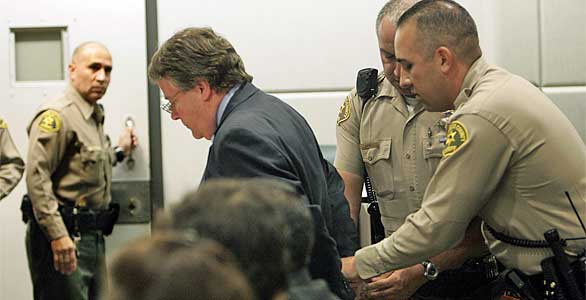
Dr.
Christopher Thompson is handcuffed by L.A. County Sheriffs
after being found guilty on all 7 counts. (Mel Melcon
/ Los Angeles Times / November 2, 2009)
|
Dr. Christopher Thompson, 60, slumped forward and held his face
in his hands after the verdicts were announced in a courtroom packed
mostly with supporters and cyclists.
Deputy Dist. Atty. Mary Stone, who prosecuted the case, asked
for Thompson to be jailed immediately, calling him a flight risk
and a safety threat to cyclists.
"There's not a cyclist in Los Angeles who would feel comfortable
with this defendant out on the road after this verdict," Stone
told the court.
Los Angeles County Superior Court Judge Scott T. Millington ordered
that Thompson be taken into custody. Thompson, wearing a dark blue
suit, grimaced and shook his head as a bailiff cuffed his hands
behind his back.
The veteran emergency room doctor, who spent more than two decades
working at Beverly Hospital in Montebello, was also convicted of
battery with serious injury and reckless driving causing injury.
He faces up to 10 years in prison when he is sentenced Dec. 3.
The three-week trial in the Superior Court's airport branch was
watched closely by bicycle riders around the country, many of whom
viewed the case as a test of the justice system's commitment to
protecting cyclists. The July 4, 2008, crash also highlighted simmering
tensions between cyclists and motorists on Mandeville Canyon Road,
the winding five-mile residential street where the crash took place.
Prosecutors alleged that Thompson stopped his car after passing
the two cyclists and shouting at them to ride single file. The cyclists
testified that they began maneuvering to ride one after the other
when they noticed Thompson's car approaching fast behind them but
that the driver passed dangerously close before abruptly stopping.
Ron Peterson, a coach for USC's and UCLA's cycling team, was
flung face-first into the rear windshield of the doctor's red Infiniti,
breaking his front teeth and nose and lacerating his face. Christian
Stoehr, the other cyclist, hurtled to the sidewalk and suffered
a separated shoulder.
A police officer testified that Thompson told him soon after
the accident that the cyclists had cursed at him and flipped him
off, so he slammed on his brakes "to teach them a lesson."
Thompson testified that he never meant to hurt the riders. He
said he and other residents were upset at unsafe cycling along the
road, which has become an increasingly popular route for bicycle
riders in recent years. But they had struggled to identify problem
cyclists.
Thompson told jurors that the riders cursed at him and flipped
him off when he yelled at them to ride single file. He stopped his
car so that he could take a photo of the cyclists and believed he
had left enough room for them.
But prosecutors alleged Thompson had a history of run-ins with
bike riders, including a similar episode four months before the
2008 incident, when two cyclists told police that the doctor tried
to run them off the road and braked hard in front of them. Neither
of the riders was injured.
Outside court, the cyclists in the case said they were relieved
at the outcome.
"Our hope is that this brings to light how vulnerable cyclists
are out there," Peterson, 41, told reporters. His face was
permanently scarred from the crash and he underwent reconstructive
surgery on his nose, which he said remains numb.
Stoehr, 30, said the crash left him unable to work for months
and that he rarely rides his bike anymore. Nevertheless, Stoehr
said he felt some sympathy for Thompson as he watched the physician
being led away in handcuffs.
"It's sad for both sides," Stoehr said. "I lost
a lot of my time and my life, and he's losing a lot of his."
Report on the San Gabriel Watershed
and Mountails Spectial Resources Study
September 3, 2009
by Steve
Messer
Last night Hans Keifer, Steve Messer and Jim Hasenauer attended the
public comment meeting put on by the National Park Service in Santa Clarita. The
following is a summary of the presentation and our thoughts, concerns and
feedback on the study.
History:
This study was mandated
by Congress through a bill introduced by Hilda Solis back in about 2002 and
passed in 2003. The study began in 2005, but this is the first much of the
public has heard of the process, including me and other CORBA and IMBA
volunteers. The study area includes much of the San Gabriel mountains, as well
as the San Gabriel Watershed. The watershed includes the San Gabriel River
drainage area within the national forest, as well as cities along the river and
its watershed such as El Monte, Hacienda Heights, La Habra, Brea, Walnut, West
Covina, Baldwin Park, Monrovia, La Verne, and the Puente-Chino Hills
area. See more on the study and
the process.
This report is continued on its
own web page.
Dirt Rag Magazine
Credits CORBA with first volunteer mountain bike patrol group
September 1, 2009
In an article on the history of IMBA's
National Mountain Bike Patrol (NMBP),
Dirt Rag
magazine reviews the role CORBA had in spearheading volunteer mountain
bike patrols. To quote:
"Although the NMBP was officially 'started' in 1994, volunteer
mountain bike patrol's roots run deep, back to the early days of
mountain biking, when trails were rife with user conflict, and blanket
mountain bike bans threatened great riding locations from coast
to coast. The Concerned Off-Road Bicyclists Association (CORBA)
was arguably the first organization to begin volunteer patrol activities
with their Mountain Bike Unit (MBU),
formed in 1988.
"Based in the Santa Monica Mountains, near Los Angeles,
CORBA was at risk of losing many great riding venues. 'Due to frequent
complaints about user conflict, land managers were throwing their
hands up,' explains Blumenthal. 'The [mountain bike advocacy] toolkit
had to be developed quickly.' So, with support from the National
Park Service and the California State Department of Parks and Recreation,
the patrol was formed, and became an overnight success, being nominated
for the 'Take Pride in California Award' in 1991."
Read the entire article, 15
Years of Service: A Look Back at IMBA's National Mountain Bike Patrol.
August
31 Public Meeting on Sullivan Canyon Closure
A community meeting is
scheduled for Monday, August 31 at 7pm at the WLA Municipal Center (1645 Corinth Ave, LA 90025) arranged by the
Brentwood Community Council and Councilmember Rosendahl's staff.
Southern California Gas Company representatives will explain their project in greater detail and provide attendees an opportunity to ask their
questions. The gas company still plans to close their canyon property to the public beginning September 1,
2009 and expect to re-open the canyon when the work is
complete. San Gabriel Watershed and
Mountains Special Resource Study
August 24, 2009
From the National Park Service, http://www.nps.gov/pwro/sangabriel/index.htm
The National Park Service is
conducting a “special resource study” of portions of the San Gabriel River
watershed and the San Gabriel Mountains. Our current newsletter presents several
draft alternative concepts for the area, each of which offers a different
collaborative, partnership-based approach to resource protection and public use
and enjoyment, while respecting existing land management and ownership. You may
download newsletter
#4 from this web site or you may request a printed copy from our office. If
you would like to provide comments on the newsletter online, click
here.
In a special resource study, a
proposed addition to the national park system receives a favorable
recommendation from the National Park Service only if it meets all of the
following criteria:
- it possesses nationally
significant natural or cultural resources;
- it is a suitable addition to the
system;
- it is a feasible addition to the
system; and
- it requires direct NPS
management, instead of alternative protection by other public agencies or the
private sector.
We will be hosting five public
meetings between August 31 and September 15 in cities throughout the study area.
The schedule is listed below. Please join us at one of the public meetings to
learn more about the draft alternative concepts, and to share your ideas,
thoughts and concerns. Your comments by mail, e-mail and internet are welcome
through October 30, 2009.
Public Meeting Locations and Times
We look forward to meeting you and hearing your ideas and
comments at one of the following public meetings:
(Note: Because of the Station Fire burning in the area, some
of these meeting times or locations may be changed. Check
here for updates!)
|
El
Monte (map)
Monday, August 31st
7pm - 9pm
City of
El Monte Senior Center
3120 N. Tyler Avenue
Diamond Bar (map)
Wednesday,
September 2nd
7pm - 9pm
Diamond Bar Center Ballroom
1600 S.
Grand Avenue
Santa Clarita (map)
Thursday,
September 3rd
7pm - 9pm
George A. Caravalho Activities
Center
Santa Clarita Room A
20880 Centre Point Parkway |
Glendora (map)
Monday,
September 14th
7pm - 9pm
Glendora Public Library
140 South
Glendora Avenue
Palmdale (map)
Tuesday,
September 15th
7pm - 9pm
Larry Chimbole Cultural Center,
Lilac
Room
38350 Sierra Highway |
As directed by Congress in July
2003 (P.L.
108-042) , the National Park
Service (NPS) is conducting a “special resource study” of portions of
the San Gabriel
River and its tributaries from the city of Santa Fe Springs to the north, and
the San Gabriel Mountains within the territory of the San Gabriel and Lower Los
Angeles Rivers and Mountains Conservancy. This area includes portions of the
Angeles National Forest, as well as many communities along the San Gabriel
River. Many people,
organizations, and agencies are working to conserve resources in this area to
provide recreational opportunities, habitat restoration, watershed improvement,
and flood protection. This study is intended to build on and complement the
efforts that are underway.
Quick links:
Sullivan
Canyon Alert!
August 22, 2009
From Michael R. Leslie, Director, Brentwood Hills Homeowners Association
(with edits by CORBA)
Starting September 1, 2009, Sullivan
Canyon will be closed while Southern California Gas rebuilds
their road and reinforces the high-pressure gas pipeline. The length
of the project and closure is uncertain, but it will last at least
through October.
Many of us in the community
who hike, ride horses, and bike in Sullivan Canyon in Brentwood know that this
canyon is a unique natural resource, with its huge oak and sycamore trees,
pretty stream and wildlife. Because of its beauty, shady paths and easy access,
Sullivan Canyon gets regular and constant use by kids, adults and senior
citizens from all over West Los Angeles, the San Fernando Valley, and
beyond.
Yet, without any meaningful CEQA
review or public notice to the community, the Southern California Gas Company
plans to rebuild the road and reinforce the pipeline, starting September 1,
2009 and continuing at least 6 weeks. The
canyon will be closed to public acces during this time. This project will have the following
environmental impacts:
There was no meaningful review of this project
under the California Environmental Quality Act (CEQA). The Gas
Company claims it is entitled to a categorical exemption from CEQA review
because the project is only a repair and maintenance project, with negligible or
no expansion of use. Yet the many admitted irreversible environmental impacts
make clear this exemption is inapplicable. Furthermore, the Gas
Company did not notify our local homeowners' groups or the Brentwood Community
Council that it was seeking permits to conduct this project, despite the fact
that many of us either live immediately adjacent to Sullivan Canyon or
frequently hike, bike and ride there.
Please read the attached excerpts of the various project
documents. We were only able to obtain these documents after making Public
Records Act Requests to the various agencies. By the time we were able to
obtain these documents, the Gas Company contended that it already has the
requisite permits for the work. Their plan was to notify the community
only after all permits were issued and the work is ready to be
commenced.
|
Update: A community meeting will be held on
Monday, August 31 at 7:00 pm. At this meeting, the Gas
Company will explain the project and address questions
from the public. Details.
|
Our only hope to have any time to review and understand this project
before the bulldozers and chainsaws are unleashed in Sullivan Canyon--and our
only chance to have any meaningful input into mitigating the serious
environmental impacts of this project--is for all of us
to immediately write, email and call the offices of Councilman Bill
Rosendahl, Assemblyman Mike Feuer, Senator Fran Pavley, the California
Department of Fish & Game, the Regional Water Quality Control Board and the
Gas Company.
We are including
contact information and email addresses below for your
convenience.
Nobody opposes the Gas
Company's efforts to properly maintain and ensure their pipelines are safe, but
we are very frustrated that they just ignored the community and only planned to
notify us only after the permits were issued and the project was
underway.
The Gas Company should welcome reasoned community input, not be afraid of
it. They should agree to pause the project, hold a community meeting, and take
advantage of the opportunity to educate and involve the many smart and
committed people in the community, including the Brentwood Community Council,
the many homeowner associations whose members will be affected, and interested
environmental groups.
Please ask the Gas Company and your public
officials to suspend the project and meaningfully consult with the community
BEFORE they start work. Once they start work, the trees will be gone and it
will be too late.
Here is the contact
information:
|
Councilman Bill Rosendahl
1645 Corinth Avenue
Room 201
West L.A., CA 90025
(310)
575-8461
Fax: (310) 575-8305
Councilman.Rosendahl@lacity.org
norman.kulla@lacity.org
|
California
Department of Fish & Game
Jamie
Jackson, Staff Environmental Scientist
Streambed Alteration Team
4949
Viewridge Ave.
San Diego, CA
92123
(626) 296-3430
jjackson@dfg.ca.gov
|
|
California Regional Water
Quality Control Board
Valerie
Carrillo
320 W. 4th Street, Suite
200
Los Angeles, CA
(213) 576-6600
Fax: (213)
576-6640
vcarrillo@waterboards.ca.gov
|
Southern California Gas
Company
Deanna Haines
Sharon O'Rourke
9400 Oakdale
Avenue, SC9314
Chatsworth, CA
91311-6511
(310) 578-2669
So'rourke@semprautilities.com
|
OTHER IMPORTANT PUBLIC
OFFICALS TO CONTACT:
Assemblyman Mike
Feuer
9200 Sunset Boulevard, PH 15
West Hollywood, CA 90069
Tel: (310)
285-5490
Fax: (310) 285-5499
ellen.isaacs@asm.ca.gov
|
Senator
Fran Pavley
2716 Ocean Park Blvd.
Suite 3088
Santa Monica, CA
90405
(310) 314-5214
Fax: (310) 314-5263
|
Supervisor Zev
Yaroslavsky
821 Kenneth Hahn Hall of Administration
500 West Temple
Street
Los Angeles, CA 90012
(213) 974-3333
(213) 625-7360
fax
zev@bos.lacounty.gov
|
|
Thanks for your prompt
action! Please circulate this news to your action networks and interested
people.
Mt Lowe
Truck Trail Closure
 June
19, 2009 June
19, 2009
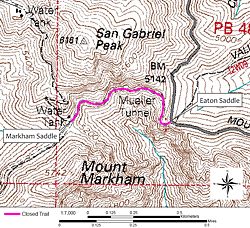
Due to a recent rock slide, the section of the Mt. Lowe Truck
Trail (Forset Trail No. 2N50) is closed from its intersection with
Eaton Saddle, continuing west 1/2 mile to its intersection with
Markham Saddle as shown in the picture. The trail was closed
starting on June 9th and the closure is in effect until June 8,
2010.
A 150 foot portion of the Mt. Lowe Truck Trail collapsed during
a rock slide making it dangerous for public access. The rock slide
has created a narrow section requiring trail users to traverse on
a narrow section with loose gravel and soil. The remainder of the
trail will remain open with signs posted at the beginning and end
of the trail in addition to signs at the actual slide area.
Poop Predicament Has Los Angeles Horse Owners
Raising a Stink
|
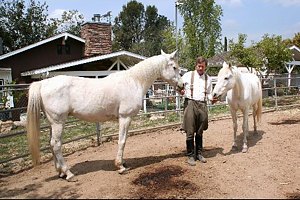
Fritz Bronner, a local horse owner and activist, feeds two of his five Arabian
geldings in the corral behind his house in the Lake View Terrace neighborhood of
Los Angeles on April 8, 2008. Los Angeles is home to some 1,500 legally
registered horses, but the actual count is more like 10,000, according to Los
Angeles City Councilwoman Wendy Greuel. Photographer: Nadja Brandt/Bloomberg
News
|
Bloomberg -- The poop hit the fan when the last manure mulcher in
Los Angeles closed shop.
The price of poop disposal is breaking the budgets of Los Angeles horse
owners, as stable owners pass along the expense of taking horse droppings to
landfills.
"The cost to get rid of this stuff has just skyrocketed,'' said Royan
Herman, 65, who runs the Peacock Hill and J-Bar Ranch stables in the San Fernando Valley
with her husband, Mark. "A lot of young families aren't able to afford a horse
anymore.''
Los Angeles, the city of Hollywood stars, is also home to about 10,000
horses, said City Councilwoman Wendy Greuel. Some estimates of the horse
population run as high as 20,000 within city limits and 45,000 in all of Los
Angeles County, which has 9.9 million residents.
Read the entire story...
Schwarzenegger
proposal to help narrow Calif.'s huge deficit would close 220 state
parks
By SAMANTHA YOUNG , Associated Press (reported in the Minneapolis
- St. Paul Star Tribune)
SACRAMENTO, Calif. - Gov. Arnold Schwarzenegger's budget cuts
could mean the closing of up to 220 state parks, among them the
home of the world's tallest tree and other attractions that draw
millions of visitors. Schwarzenegger this week recommended eliminating
$70 million in parks spending through June 30, 2010. An additional
$143.4 million would be saved in the following fiscal year by keeping
the parks closed.
"This is a worst-case scenario," said Roy Sterns, a
spokesman at the state parks department. "If we can do less
than this, we will try. But under the present proposal, this is
it."
Among the parks that could be closed, the parks department said
Thursday, are Lake Tahoe's Emerald Bay, Will Rogers' Southern California
ranch and Humboldt Redwoods State Park, which boasts the world's
tallest tree, a giant that tops 370 feet. Even the Governor's Mansion
in Sacramento is on the list.
The Legislature last year rejected the governor's proposal to
close 48 state parks. But lawmakers said that with California's
budget deficit now at $24.3 billion, the situation is so dire that
it is likely some parks will close.
"Things that were previously dead on arrival are a lot more
viable in a crisis like this," said Democrat Jared Huffman,
chairman of the Assembly's parks and wildlife committee. "I
think some cuts are coming to the parks, and they'll be cuts I won't
like and the public won't like."
The state parks department said a $70 million cut would leave
it with enough money to run just 59 of California's 279 state parks.
The state's famed park system attracts nearly 80 million visitors
a year. William Randolph Hearst's Castle on the Central Coast and
a dozen other so-called moneymakers would remain open, as would
many Southern California beaches that attract millions of visitors
year round.
But others that could close include: Fort Ross State Historic
Park, the southernmost Russian settlement in North America; Bodie
State Historic Park, one of the best-preserved Old West ghost towns;
and Big Basin Redwoods, the oldest state park.
The proposal has angered conservationists and some Democrats
in the Legislature, who say California's parks are treasured spots
that help the state and local economy.
"State parks draw tourism to California," State Parks
Foundation president Elizabeth Goldstein said. "This proposal
makes the budget situation worse."
The foundation estimates the state gets a $2.35 return for every
dollar it spends on parks.
California spends roughly $400 million a year running 279 state
parks and beaches, with roughly a third of the money coming from
the state general fund. The rest comes from user fees, which account
for slightly more than a quarter of the revenue; bond funds; gasoline
taxes; federal money; and other sources.
Assembly Minority Leader Mike Villines said the state cannot
afford to subsidize state parks when lawmakers are being asked to
make severe cuts in even more vital areas.
"Parks are just not going to be a priority over public safety
and education, as much as we hate to see them close," Villines
said.
At least 2,000 park rangers, biologists, lifeguards, interpreters,
architects and maintenance workers would be laid off if the proposal
is adopted, said Sterns, the parks spokesman.
The layoffs would be in addition to 5,000 state positions the
governor has already recommended cutting.
"When you cut that much, you have to let go highly trained
teams of biologists that you can't get back in a year or two,"
Huffman said. "It's a myth to think you can mothball the entire
system. These cuts will cripple the park system for a decade or
more."
Angeles
Chapter of the Sierra Club works to keep mountain bikes off
trails in Los Angeles
Chapter activists working to keep city
parks hiker-friendly and mountain-bike free
By Carol Henning, Co-Chair, Southern
Sierran Editorial Board. The following article appears
in the June 2009 edition of the Southern
Sierran, Vol 65 No6.
You're hiking down a steep trail, enjoying the view, trying to
remember the name of a trailside wildflower when, whoosh! Inches
from your left arm a mountain bike comes careening down the trail.
Most close encounters with mountain bikes leave all parties unharmed
- most, but not all.
"We have seen conflicts," reports Kevin Regan of the
Department of Recreation and Parks. There have been "close
calls and accidents." A Los Angeles City Ordinance prohibits
bicycles on unpaved trails in all City parks. This ordinance was
reaffirmed unanimously by the City Council in 2000. Moreover, this
April, the Angeles Chapter passed a resolution supporting efforts
to uphold the existing ordinance.
The backstory has been documented by Sierra Club hike leader,
AI Moggia. 1995 saw the Concerned Off Road Bicycle Association (CORBA)
requesting access to dirt trails in city parks from the Department
of Recreation and Parks (DRAP), whereupon a Mountain Bike Task Force
was formed including CORBA, DRAP, the L.A. Department of Transportation
(LADOT and the L.A. Bicycle Advisory Committee (BAC). The L.A. City
Planning Department spooned up this alphabet soup and other entities
to formulate a Bicycle Plan Element. In 1996, the DRAP Commission
denied requests for a mountain bike event in Griffith Park, citing
the municipal ordinance and an opinion by the City Attorney. Also
in 1996, the City Council adopted the Bicycle Master Plan as part
of the Transportation Plan Element of the General Plan of L.A. City.
DRAP, CORBA, DOT and BAC studied the feasibility of opening City
parks to mountain biking.
In 1998, LADOT City Bicycle Coordinator Michelle Mowery and BAC
member Alex Baum made a special presentation to DRAP. There was
minimal public notice of three community meetings in 1999, but over
400 residents attended. 95 percent of the attendees expressed their
opposition to biking on city parks' dirt trails. Despite the apparent
dearth of public support, Elysian Park was selected in January 2000
for a mountain bike pilot program. Word of mouth and work by the
Citizens' Committee to Save Elysian Park brought out more members
of the public to a meeting at Grace Simons Lodge, where they opposed
the mountain bike pilot program. A subsequent meeting brought out
more community members, a vast majority of whom opposed the program.
Elysian Park was spared, and the City Council passed the motion
rejecting changes to the ordinance prohibiting mechanized use of
City park trails.
Mountain bike advocates tightened the straps on their helmets
and soldiered on. Perhaps feeling jilted by Recreation and Parks,
they decided to hop onto the handlebars of the Department of Transportation.
But is this not an issue of recreation rather than transportation?
The DOT's Bicycle Master Plan is about cycling in the City. The
focus is presumably on the transportation aspects of the bicycle
plan, not on the thrills of jouncing down a narrow dirt trail, dodging
(one hopes) hikers, runners and equestrians.
A September, 2008, memo by Jordann Turner, Bike Plan Project
Manager, wondered "why and how the meetings in the past between
cyclists/equestrians/etc. have been contentious." Might it
have been those accounts of clobbered hikers, frightened horses
and thrown riders? To avoid this sort of testimony, DOT decided
to use a consultant who has experience with this subject matter
to conduct small mediated working-group meetings. Attendance at
these meetings was by invitation only, with no notice to the public.
The Los Angeles Bike Plan Stakeholder Advisory Group consists of
nine invited participants - three hikers, three mountain bikers
and three equestrians. Where are the runners? Where are the dog-walkers?
Where are the homeowners associations' representatives? They were
not invited to the table.
It seems clear that the question is not whether mountain bikes
should be permitted in City parks but which parks should allow them
and how should access be designed. Two Sierra Club members represented
hikers' interests at the first meeting. Neither was an official
representative of the Angeles Chapter. After the show, the distinction
between being a Sierra Club member and a designated Sierra Club
spokesperson was explained to the facilitators. supposedly neutral
consultants with ties to to the Osprey Group of Boulder, Colorado,
whose website documents its experience securing trail access for
mountain biking.)
|
Webmaster's note: Michelle Mowery, Bicycle
Coordinator for the LA City Dept of Transportation (LADOT)
testified recently that "The Needs Assessment ...
identified bicycling and walking trails as the number
one need. ... It identifies equestrian use as last on
that list. So it's clear that there is a need and a
desire for bicycle facilities within the parks."
For more on this issue, including video clips of
outrageous claims during testimony, visit our LA
City Parks web page.
|
Club
policy on mountain bikes opposes their use in officially designated
wilderness areas unless determined to be appropriate by analysis,
review and implementation. The Park City Agreement (1994) between
the Sierra Club and the International Mountain Bicycling Association
called for site-specific analyses and stated that not all non-wilderness
trails should be opened to bicycle use. Of concern are the effects
of off-road biking on soil erosion, the impacts on plants and animals,
and the displacement of other trail users. When considering the
introduction of off-pavement bikes to a park, Sierra Club guidelines
mandate consideration of these issues: whether the safety and enjoyment
of all users can be protected, and whether there has been a public
review and comment procedure for all interested parties. In this
case, the response is no.
A late 2008 DRAP Citywide Parks Needs Assessment demonstrated
virtually no demand for mountain biking [Webmaster's note:
See the inset at right to evaluate the accuracy of this claim];
yet, a small advocacy group seems to be trying to sneak its agenda
past an unsuspecting public. Most of us have not been invited to
join the discussion, but we can make our voices heard. Send letters
and e-mails to LADOT, to DRAP and to your city councilmember.
CORBA
in the News:
Volunteers wage
weekly fight with mountain trail erosion
From
the Ventura County Star, Sunday, April 12, 2009
|
Burt
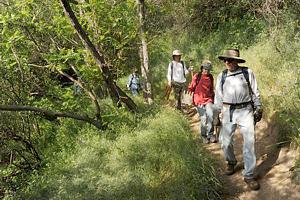
Elliott, trail maintenance coordinator, leads volunteers
and fellow members of the Santa Monica Mountains Trail
Council to the Saturday work site. Volunteers cut back
shrubs, cleared minor slides and upgraded runoff canals
along a 1.4-mile stretch.
|
Encumbered by heavy tools, a dozen members of the Santa
Monica Mountains Trails Council met Saturday morning in the
dirt parking lot of a trailhead on the Backbone Trail. Their mission:
trail maintenance.
Oxnard resident Dave Edwards, group leader, said the purpose
of the volunteer, nonprofit organization is establishing and maintaining
the public trail system throughout the Santa Monica Mountains. That’s
why he and his colleagues were shouldering pickaxes, grappling with
loppers (oversized pruning shears) and swinging McLeods, the five-tooth
rake with a cutting edge used by California Division of Forestry
firefighters. They were heading out on a two-mile hike to combat
trail ruts and erosion from rain and mountain bikes by digging water
bars to drain rainwater from the trial.
There also was a report of two small landslides near the mountain
crest that needed to be checked out and cleared if necessary. “We
spend a lot of time putting in drains,” said Edwards, 62. “Maintaining
these trails gives all of us a sense of accomplishment. We may only
do 300 or 400 feet (of trail) today, but we keep coming back, even
though the pay is lousy.”
And they do come back — every weekend and one Wednesday a month,
10 months a year. July and August are a respite because of the heat.
Edwards said they are often joined by the Santa Monica Mountains
Task Force of Sierra Club or members of Concerned Off-Road Bicyclists
Association (CORBA).
Burt Elliot, 76, of Thousand Oaks said he’s been a Trails Council
member “going on 17 years.” “I hike, run and mountain bike the trails,”
he said, striding briskly up an incline. “I’m a retired engineer,
and I like to build things. It’s also neat to have a relationship
with the park. Our crew leaders are actually unpaid staff.”
|
CORBA
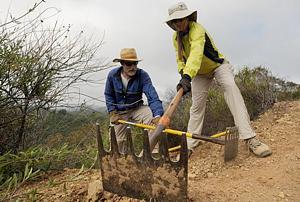
members Steve Clark of Newbury Park and Claudia Mitchell
of Oxnard team up Saturday to groom Backbone Trail with
the Santa Monica Mountains Trail Council.
|
At age 22, Celina Armenta was one of three in the group not eligible
for AARP membership. Edwards said a lot of Trails Council members
are retired, giving them more free time. Armenta drove from Downey
to join the group for the first time. She graduated from UC Santa
Barbara, but only recently became interested in hiking. “I’m not
much of a hiker. I grew up in Los Angeles, where everything is flat,”
she said between gasps for air. “All these older people can outhike
me. They tell me how to fix the trail and the names of flowers and
I say, ‘Cool.’ I definitely want to do this some more,” she added.
“And I’m going to make my lazy friends come out here — forget the
YMCA.”
Armenta said she might bring her friends to meet her new hiking
friends at the 28th Santa Monica Mountains Trail Days — 2009. The
three-day event will kick off April 24 at Point Mugu State Park.
It’s a weekend devoted to building new trails and restoring old
ones in partnership with the Trails Council, California State Parks,
CORBA, California Native Plant Society, the National Park Service,
Santa Monica Mountains Natural History Association, Temescal Canyon
Association, Santa Monica Mountains Task Force of Sierra Club and
Conejo Sierra Club. Camping is free for trail workers. All volunteers
are welcome; trail work experience is not required. Camp will be
at the Danielson Ranch multiuse site under sycamore and oak trees
in the heart of the park.
For more information, call 818-222-4550 or visit http://www.smmtc.org.
More photos are available in the VenturaCountyTrails.org photo
gallery.
Jeff
Klinger, chairman of CORBA, responds to the statement in this
article that "trail ruts and erosion... [are caused by] rain and mountain bikes"
The article indicates that the trail erosion was caused by two
factors: rain and mountain bikes. Identifying one user group without
mentioning the array of factors that contribute to erosion does
not fairly portray that group and implies that erosion is somehow
use-specific, when it is not.
Independent studies demonstrate that mountain bikes cause no
more surface erosion than other types of trail use. And, many factors
contribute to the erosion of trails, including natural and human
sources. Water causes the most damage to trails, as it is the most
erosive force of nature (that’s how we got the Grand Canyon). All
trail recreation has some impact, however that impact is increased
or decreased as a result of many factors, including trail design.
Sustainable trail design and properly constructed water control
features serve to minimize erosive effects of nature and trail
users.
The bottom line is that trails are built by people primarily
for recreational use. Because trails are unprotected by vegetation
and exposed to the elements, particularly concentrated rainwater
erosion and continuous plant growth into the open trail space, trails
must be maintained or they will erode away and be overtaken by vegetation.
Hiking and biking groups such as the Santa Monica Mountains Trails
Council and Concerned Off-Road Bicyclists Association take a leadership
role and deploy volunteer teams year-round to maintain these precious
resources for the community to enjoy. We welcome everyone to come
out and join us.
|
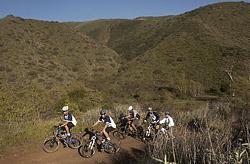
Members of the Channel Islands High School Mountain Biking
team make their way up a hill at the Point Mugu State Park on March 27, 2009.
The team finished second place in the first race they participated in. Only one
student had a bike last month when the team formed, leaving the rest of the
students to borrow bikes.
|
Mountain
Biking in the News:
Channel Islands
High forms mountain bike club Trailblazers
From
the Ventura County Star, Sunday, April 12, 2009
Luis Angel Ramos received a cheap mountain bike as a gift when
he was 12. Ramos would ride it around the city streets in Oxnard
and occasionally go as far as Camarillo. But Ramos realized there
was an entire world beyond the pavement and wondered what it would
be like to explore the back country on two wheels. The Channel Islands
High senior never thought he would have the chance until this year.
Defying cultural stereotypes and overcoming financial hurdles,
Channel Islands High has formed a mountain bike club. The Raiders
are the only Ventura County team participating in the inaugural
season of the Southern
California Interscholastic Cycling League. They finished second
in their first race last month while competing against many teams
with more experience and better equipment. Their final race is May
3 at the Cow Pie Invitational in Santa Ynez.
“I really, really, really like it,” Ramos said. “The views are
amazing when you are riding. Every time we are out high on a mountain,
you can see all of Oxnard. It is just beautiful.”
|
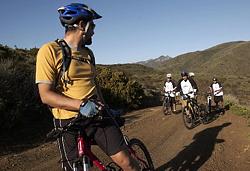
Channel Islands High School Mountain Biking team assistant
coach Alfredo Salcido of Oxnard takes a break at the Point Mugu State Park
|
The club was the brainchild of Erick Kozin, the owner of NEMA
International, a mountain bike apparel company in Ventura. Kozin,
34, who raced professionally for five years, heard about the high
school league while attending the CORBA
Fat Tire Festival at Castaic Lake.
Kozin thought it would be great to have a team from the county participate.
His brother is a counselor at Channel Islands, so Kozin ran the
idea by him and was put in contact with school administrators.
“I just really wanted to give back and do something kind of cool,”
said Kozin, a Hueneme High graduate. “When I was in high school,
we didn’t have anything like this. If you wanted to ride your bike,
you were on your own. This is an opportunity for kids to do something
positive that can stick with them forever.”
Channel Islands announced the formation of the club over the
school intercom last November. Kozin expected maybe a handful of
kids to show up for the first meeting, but ended up with more than
20. Most of the students expressed an interest in trying something
outside of the average sports, although only one or two even owned
a bike.
“It’s not your typical mountain bike team,” Kozin said. “These
kids didn’t have any experience. They are learning as they go.”
Sophomore Shaylee Quezada wasn’t sure if she could join the club
because she couldn’t afford the $200 fee. But Kozin assured students
they wouldn’t be turned away as long as they made one promise. “If
you can commit to this like you would any other sport, we will provide
you with everything you need to be part of the club,” he said. “You
just have to attend races and work hard.” That was a relief to Quezada.
When asked if she ever owned a bike before, the outgoing 15-year-old
replied, “I don’t think tricycles count.”
|
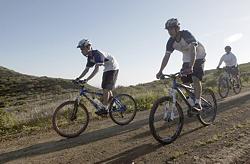
Channel Islands High School Mountain Biking team members
Luis Angel Ramos, from left, Humberty Solorzano and Shaylee Quezada make their
way down a hill at the Point Mugu State Park
|
Helping hands
Quality mountain bikes can cost anywhere from $500 to $4,000,
a price nobody on the team can afford. But Channel Islands is receiving
assistance from several sources to keep the team on the trails.
Trek Bike Store in Ventura has loaned the club two bikes for this
season while Kozin and assistant coach Alfredo Salcido are providing
the other four. Last week, the Channel Islands Bike Club approved
a $6,000 grant for the high school team, and Albabici LLC — an Italian
cycling supplier in Oxnard — has given the team free shoes, bike
seats and bags.
The team meets for practice three days a week after school. Kozin
and Salcido use their vans to transport the team and bikes to local
trails for training. “I have a love-hate relationship with going
downhill,” Quezada said. “I like going really fast, it’s just that
it is really bumpy and my bike wants me to get off of it sometimes.
But I have to sit through and get down that hill.”
Learning proper mountain biking skills, technique and trail etiquette
has instilled confidence in sophomore Robert Equihua. “It is awesome
because you can go places where you have never been and it is very
challenging,” he said. “You accomplish things you never thought
you could actually do.” Like finishing second in the first race
of the season despite hardly anybody knowing where Channel Islands
was even located. “It was intimidating to see the other teams with
a lot more experience that just had everything maybe handed to them,”
Kozin said. “But our team left there feeling so good about themselves,
and that was probably the biggest reward. I was probably more excited
than they were.”
Blazing new trails
Quintin Easton is the president of the Southern
California Interscholastic Cycling League. After being laid
off from his job at Wells Fargo two years ago, Easton went on a
mountain bike ride to figure out the next step in his life. He always
enjoyed working with kids, and realized many were deprived of the
joys of mountain biking. Easton wanted to start a series races for
high school students, and discovered there was already a similar
league in place in Northern California. He contacted the founders
of the Northern
California High School Mountain Bike Racing League, and inquired
about extending it to Southern California. The founders said they
would love to, but didn’t have the money.
|
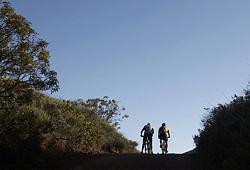
Channel Islands High School Mountain Biking team member
Robert Equihua, 15, and assistant coach Alfredo Salcido of Oxnard make their way
up a hill at the Point Mugu State Park
|
Easton went to his father-in-law Jim Easton, who is the president
of the Easton Sports Inc., which is known for producing archery
and baseball and softball bats. “The Easton Sports empire was built
on archery, but he told me there was money set aside for cycling
as well,” Quintin Easton said. “He has $40 million in the Easton
Foundation he has to give away. So we put together a plan and he
liked it and gave the league $100,000 to expand.”
The four-race SoCal League mirrors the NorCal League in every
way, but Quintin Easton has more ambitious goals for mountain biking.
He wants to make the sport available at all public and private schools
across America, and Channel Islands is a perfect symbol for his
quest. “We believe very strongly that you can’t have tryouts for
a school team. If you want to ride, you are invited to ride. You
don’t have to be an expert and you don’t have to own your own bike,”
Easton said. “All schools and all kids from any socioeconomic backgrounds
are welcome.”
Ramos is slowly convincing his skeptical sister of that premise
after recording his first individual top-10 finish last weekend.
“She was joking around saying I was racing out there with the rich
kids,” Ramos said. “She was basically saying Mexicans don’t really
mountain bike, everyone else does. That is why I am trying to break
those barriers. Hopefully in a few years it will be more common
and more Ventura County schools will be doing it.”
Subaru/IMBA
Trail Care Crew Visiting Santa Barbara March 26 - 29
Santa Barbara, March 7, 2009 - The International Mountain Bicycling
Association's (IMBA)
Subaru/IMBA Trail
Care Crew will be in SANTA BARBARA, March 26th through March
29th to talk trails, teach people sustainable trail building technique,
and spend quality time on trail with volunteers. The visit is one
of 70 stops on the 2009 schedule. Everyone is invited to attend
the weekend's events – but registration is required for the Trail
Building workshop.
The award-winning Subaru/IMBA Trail Care Crew program includes
two full-time, professional teams of trail experts who travel North
America year-round, leading IMBA Trail building Schools, meeting
with government officials and land managers, and working with IMBA-affiliated
groups to improve mountain biking opportunities. IMBA's Crews have
led more than 1,000 trail projects since the program debuted in
1997.
The Crews teach "sustainable" trail building, which
means building trails that last a long time and require minimal
maintenance. This helps reduce trail damage, protects the environment,
and enhances visitor enjoyment.
Now in its eighth year, the Subaru/IMBA Trail Care Crew program
is more popular than ever.
The Subaru/IMBA Trail Care Crew program has inspired great volunteer
trail work across the U.S. and abroad - a big help to government
agencies and land managers who have limited funding for trail construction
and upkeep.
Coming to SANTA BARBARA are Subaru/IMBA Trail Care Crew members
Inga Beck and Jason Van Horn. Beck hails from the San Francisco
area while Van Horn is from Oregon. They bring a unique combination
of professional experience to the program – from coaching mountain
bike skills, working with a multitude of environmental organizations,
to swing dancing and yoga – on top of being trained as some of the
country's top trail builders. They're also committed volunteers
who have logged hundreds of hours building trails and performing
outreach work with a host of public agencies.
All are welcome to join the Subaru/IMBA Trail Care Crew leaders
when they come to town. Below is a schedule of events that are open
to the public:
- March 26th, Presentation “Club Care – Reinvigorating Your
Club”: 6:30pm - 8:30pm, Faulkner Gallery - Santa
Barbara Central Library, 40 East Anapamu Street. Open
to the public.
This presentation focuses on techniques that advocacy
groups across the country have used to reach goals, overcome,
challenges, and build up their community. Any trails,
outdoor, environmental, or sports based organization will
benefit from this workshop. Included will be ideas
on sustaining boards of directors, recruiting members, and
making sure that everyone has a great time participating
in their organization. No cost.
- March 28th, IMBA Trail Building School and trail work.
8:30am - 5:00pm, Louise Lowery Davis Center 1232
De La Vina St Santa Barbara, CA: Pre-registration is
required. Registration: http://go.imba.com/santabarbara
or register by email to chris.orr@sbmtv.org
or ray@sbtrails.org.
This workshop instructs hikers, cyclists, and equestrians
sustainable trail building/maintenance philosophies and
trains volunteers and land managers to use these skills
on their trails and in their community. The
workshop will include a half day (8:30am -12:30pm) in class
instruction and a half day on a trail applying and refining
skills. Location of the trail will be announced in the workshop.
Carpooling is strongly encouraged. No cost.
- March 28th, After Trail Work Social with the IMBA
TCC, Location TBA
- March 29th, TCC Fun Ride , 10am Location TBA
For more information and to register for the IMBA Trailbuilding
School, contact Chris Orr (chris.orr@sbmtv.org)
or register at http://go.imba.com/santabarbara
For a complete list of visit dates, photos and additional information
on the Subaru/IMBA Trail Care Crew visit www.imba.com.
The previous visit of the Subaru/IMBA Trail Care Crew to
the region was to Ventura County in 2005. You can view the photo
galleries of trailwork
and the following recreational
ride.
About Subaru of America, Inc.
Subaru of America, Inc. is a wholly-owned subsidiary of Fuji
Heavy Industries Ltd. of Japan. Headquartered near Philadelphia,
the company markets and distributes all-wheel drive Subaru vehicles,
parts and accessories through a network of nearly 600 dealers across
the United States. Subaru of America, Inc., is the only car company
that offers symmetrical all-wheel drive as standard equipment on
every vehicle in its product line. Subaru has been the best-selling
import wagon in America for the past 20 years, based on R.L. Polk
& Company new vehicle retail registration statistics calendar
year-end 2002.
About IMBA
The International Mountain Bicycling Association creates, enhances
and preserves trail opportunities for mountain bikers worldwide.
Since 1988, IMBA has been bringing out the best in mountain biking
by encouraging low-impact riding, volunteer trail work participation,
cooperation among different trail user groups, and innovative trail
management solutions. IMBA's worldwide network includes 32,000 individual
members, more than 500 bicycle clubs, and 400 corporate partners
and dealer members. For more information visit www.imba.com.
About SBMTV
Santa Barbara
Mountain Bike Trail Volunteers is a group of advocates dedicated
to building a trail community and sustainable trail system through
continued volunteer work. The Santa Barbara Mountain Bike Trail
Volunteers formed over 20 years ago in response to threatened trail
closures. Since then the Trail Volunteers have worked hard to promote
responsible mountain bike trail use and volunteer trail maintenance
activities. We are currently focusing our energy on rider education
and the development of closer ties between members of the trail
community.
About the Santa Barbara County Trails Council
Since 1969, the Santa
Barbara County Trails Council has dedicated itself to working
with local government agencies and other organizations on the development
of a safe and sustainable trail network, acquisition of new trails
and support for volunteer trail maintenance programs. SBTC plays
a key role in bridging the differences among trail user groups as
we work towards building a network of trails that serve the entire
community.
COSCA
Seeks Volunteers for Trailhead Outreach
March 2, 2009
The Conejo Open Space Trails Advisory Committee (COSTAC) of
the Conejo Open Space Conservation Agency (COSCA)
needs two volunteers for any of the Trails Outreach events.
These events are
scheduled for Saturday or Sundays from 8:30 to 11:00 a.m. at various
COSCA trailheads (see below). The volunteers will provide
information to hikers, mountain bikers and runners about the Conejo Open Space,
such as
- trail maps
- hike and event schedules
- environmental education
- COSCA volunteer opportunities
Training is provided on site on the day of the event.
Please email Steve
Forman (Outreach Coordinator) if you would like to help out on any
of these dates forman3d@hotmail.com
March
7th: Los Robles (south end of Moorpark Rd.)
May 16; Lang Ranch
June 27:
Los Robles
October 3rd: Wildwood
Energy Bar
Recall Due to Salmonella Contamination
A very large number of products that contain peanut butter manufactured
by the Peanut Corporation of America have been recalled because
of salmonella contamination. Among them are some of our favorite
energy bars. Check the list
of recalled energy bars. If you have any that are on the list,
return them to the place you purchased them. Do not eat them
under any circumstances!
Fighting
to Save Mankind: CORBA's Jeff Klinger sees the big picture
From Mountain
Bike Action magazine, December 2008, page 70
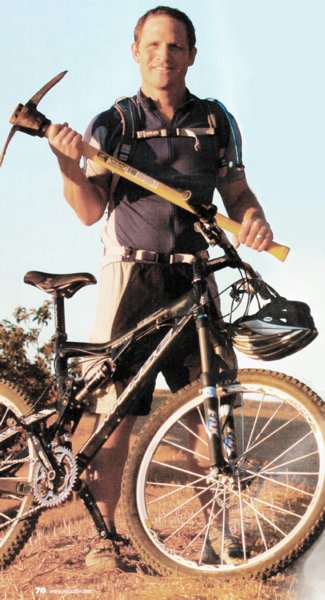 "It's
one thing that I'm alive today because of mountain bikes,"
reflects Concerned Off-Road Bicyclists Association's (CORBA) Jeff
Klinger. "I want everyone in Los Angeles to have the same chance
as me. One of the greatest things about mountain biking is that
it is so much fun and so healthy. America needs it bad. We are overtaken
by obesity, diabetes and other poor health issues related to nonactivity.
Mountain biking is one of the solutions. It's stimulating, never
gets boring. and is a very addictive cardiovascular exercise. You
can't stop doing it! CORBA's goal is to further mountain bike recreation
in and around the Los Angeles area. "It's
one thing that I'm alive today because of mountain bikes,"
reflects Concerned Off-Road Bicyclists Association's (CORBA) Jeff
Klinger. "I want everyone in Los Angeles to have the same chance
as me. One of the greatest things about mountain biking is that
it is so much fun and so healthy. America needs it bad. We are overtaken
by obesity, diabetes and other poor health issues related to nonactivity.
Mountain biking is one of the solutions. It's stimulating, never
gets boring. and is a very addictive cardiovascular exercise. You
can't stop doing it! CORBA's goal is to further mountain bike recreation
in and around the Los Angeles area.
"What happens here is recognized worldwide, and CORBA isn't
one person." continues Jeff. "It's a team effort by a
large group of extremely dedicated mountain bikers. Advocacy is
24/7. It takes a lot of time and patience. To reclassify a hiking
trail as a multi-use trail is a lengthy process. First, the land
managers have to do an environmental study. We have to check if
endangered plants and animals inhabit the trail area. It requires
working with local, state and national land agencies. To make it
happen, CORBA and loyal members have to speak publicly, attend numerous
meetings, and do a lot of letter writing.
"I have a Masters in Environmental Studies," adds Jeff.
"It helps bring CORBA more success. When mountain biking hit
in the late 1980's. the Santa Monica Conservancy shut the trails
down. Since then, we've proved what a legitimate, respectful and
conscientious group of people mountain bikers are. One of our greatest
successes is opening up the Will Rogers part of the Backbone Trail.
That is primarily what CORBA does; we rally for mountain bikers
to keep the trails open. From the Santa Monica Mountains we have
branched out to the San Gabriels, Palos Verdes, Verdugos, Santa
Susannas and Ventura County. We also hold organized rides, a youth
adventure program, monthly trail workdays, and monthly skill classes.
EPILOG: Mountain biking taught Jeff Klinger about himself.
Half a year ago he noticed that his body was no longer reacting
well to intense effort. Jeff went to the doctor and insisted that
there was a major problem. They found hereditary blockage in the
coronary artery and immediately performed emergency surgery. That
is how mountain biking saved Jeff's life. CORBA can be reached by
calling (818) 773-3555 or at www.corbamtb.com
SoCal Interscholastic Cycling League Launched
with Backing from Easton Sports Development Foundation II
August 29, 2008
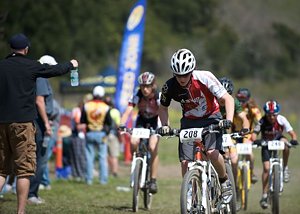 OAKLAND , CA - The Northern California High School Mountain Bike
Racing League (NorCal League) will launch the Southern California
Interscholastic Cycling League (SoCal League) in the 2009 academic
year with grant support from the Easton Sports Development Foundation
II. OAKLAND , CA - The Northern California High School Mountain Bike
Racing League (NorCal League) will launch the Southern California
Interscholastic Cycling League (SoCal League) in the 2009 academic
year with grant support from the Easton Sports Development Foundation
II.
The new league is based on the successful model of the NorCal
League, now in its eighth year, which currently has reached a membership
of over 400 high schoolers, 150 coaches, and 35 schools from within
the region. Matt Fritzinger, Executive Director of both the NorCal
and SoCal leagues, said, "We are tremendously grateful for
the generosity of Mr. Easton and his foundation. The grant allows
us to launch a new league, and that has been a dream of ours for
several years. With the SoCal League, we'll be fostering the same
values of life-long physical fitness, community, and self-confidence
combined with athletic competition that has been so successful in
Northern California."
The NorCal League has developed methods and curriculum for introducing
young riders to the world of mountain bike racing, as well as recruiting
and training coaches that are committed to producing amateur athletes
who are gracious in both victory and defeat, and are respectful
of their environment and community. The SoCal League is one of the
first few recipients of an ESDF II grant in part because of the
proposal's emphasis on coaching, community, and making cycling a
main-stream high school sport. Fritzinger said, "We know that
good coaching means working closely with families, and helping athletes
create a balanced life perspective. We aim to take the SoCal high
school mountain bike teams in the same direction as we have in Northern
California working to make cycling as important as baseball, football
and soccer in the fabric of our high schools."
For information about the SoCal League visit www.socaldirt.org
and visit their booth at CORBA's
Fat Tire Fest on October 12, 2008. Also, visit CORBA's SoCal
League web page.
Urge California Decision Makers to Adopt Bike-Friendly Land
Protection Measures
June 27, 2008
From the International
Mountain Bicycling Association
The Assembly Committee on Natural Resources recently passed a bill --
authored by Assembly member Noreen Evans (D-Santa Rosa), Chair of the Assembly
Democratic Caucus -- that directs the state to assess the suitability of
numerous state lands in Northern California for Wilderness designations.
Bicyclists value natural landscapes and access to trails that bring us closer
to nature. Because our activity is a quiet, low-impact and human-powered use
that is compatible with wild settings, we believe many of these Northern
California areas should not be protected with Wilderness designations, which
would effectively prohibit bike access.
IMBA California Policy Advisor Tom Ward has testified in front of the
committee and many members expressed their support for mountain biking — but
they still passed the bill out of committee. Unless they hear from the mountain
bike community, the bill will keep moving and suggest massive closures at three
important parks.
There are many ways to protect these important places without banning the
existing use of mountain bicycling. Cyclists need to rally and make sure their
assembly member hears from our constituency.
Take Action!
IMBA's simple online comment form takes seconds to complete!
Tell the governor and your state senator and representative you support land
protection that allows bicycling to continue.
A quick phone call can be even more effective. Click
here to find contact information for your elected officials.
Please also forward this alert to all mountain bikers, bike shops and
industry employees you know.
Additional Information
Assembly Bill (AB) 2923 passed from committee with a 6-2 vote and awaits
further review in the Assembly Appropriations Committee
Sponsored by the California Wilderness Coalition, the bill directs the
Resources Agency and the State Lands Commission to assess whether selected state
lands merit wilderness designation.
Mountain biking is an existing use in several of these areas, including
Robert Louis Stevenson State Park and Henry W. Coe State Park.
Mountain bikers also have a long-standing proposal to create shared-use
trails in Austin Creek Redwoods State Park.
Because Wilderness designations would prohibit bike access in these parks, we
urge that these areas should be protected through other means.
IMBA California’s Tom Ward is meeting with key Senate staffers and will keep
the pressure up to ensure that mountain bike access is protected.
New Rancho Palos Verdes policy for bikers, hikers and equestrians satisfies few
June 7, 2008
|
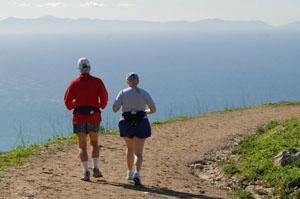
Runners take the Burma Road through the Portuguese Bend Reserve. Because preserving habitat takes top priority, the city of Rancho Palos Verdes has established limits on the use of trails in the reserve. The trails were reopened to the public under the new rules Friday. (Steve McCrank, Staff Photographer)
|
By Melissa Pamer, The Daily Breeze Staff Writer
With some of the most sublime ocean views in the South Bay, the steep, narrow trails in Rancho Palos Verdes' Portuguese Bend Reserve draw fierce allegiance and occasional territoriality from hikers, mountain bikers and equestrians alike.
Now, following the reopening Friday of the 417-acre canyon park after a four-month trail closure, a new set of rules - dictating which trails may be traversed on foot, on bike or on horseback - will be put to the test.
Few are pleased with the new access plan, which was created after months of debate by a citizen committee and approved by the City Council earlier this year. "We've gone with the least bad solution," said Gordon Leon, a member of the committee who counts himself as a representative of all three "user groups." "The fact that nobody's happy means that everybody had to make compromises. Any way you look at it, by allowing people up there, you impact habitat," Leon said. "When it comes right down to it, at the top of the priority list is habitat. Then there's everything else."
Under the plan, cyclists will have access to far fewer trails, and many of the most challenging and popular paths will be off-limits to bikes. More than half of the trails will be closed to all users. There are no signs barring access to closed trails - so if a trail isn't marked, its use isn't allowed,
officials said.
Enforcing the new rules may prove a challenge, council members acknowledged at a Tuesday meeting in which they approved the reopening of the reserve.
"When I last looked, the signage was still inadequate," Councilman Tom Long said before voting in favor of the reopening. "We need resources to enforce the rules."
For now, the Sheriff's Department is responsible for enforcement. City staff will request sporadic visits from deputies if there are regular reports of illicit trail use. Penalties for violators - currently subject to a fine of up to $1,000 under city code - may change if the city follows a Sheriff's Department recommendation to give only a written warning to first-time offenders.
 So far, it's clear that what some called a "lawless" atmosphere hasn't entirely changed.
Earlier last week, before the side trails reopened, evidence could be seen that the closure had not left the area to the lizards. Prints from hiking boots, hooves and tires marked dusty side trails. Hikers could be seen in off-limit areas of the reserve. At one juncture, a new trail sign had been shorn off at its base. So far, it's clear that what some called a "lawless" atmosphere hasn't entirely changed.
Earlier last week, before the side trails reopened, evidence could be seen that the closure had not left the area to the lizards. Prints from hiking boots, hooves and tires marked dusty side trails. Hikers could be seen in off-limit areas of the reserve. At one juncture, a new trail sign had been shorn off at its base.
It may take time for the new rules to be respected, said Andrea Vona, executive director of the nonprofit Palos Verdes Peninsula Land Conservancy, which manages the reserve along with other nearby areas. She's hopeful that signs and a new map will keep users in line.
"Our general philosophy is it's going to take community buy-in - to make this a successful reserve - from all user groups," Vona said.
The city's "timeout," which began Jan. 31 and was intended to allow the land to heal from overuse, interrupted a decadeslong period of unregulated recreation in the canyon area.
Purchased in 2005 for $17 million - funded largely by grants and $4 million raised from the community - the coastal sage scrub-covered land had been long used by the public with the tacit approval of a private owner.
The trails that crisscross the hillside, some running parallel and just feet from each other, offer scenic hiking and horseback riding. With its sharp turns and steep descents, the area became popular beginning in the early 1980s with mountain bikers, some of whom cleared brush for spots to perform tricks.
"It's been sort of a free-for-all," said Ara Mihranian, the city's principal planner. "There were areas that were used for jumps and free-riding. That's no longer part of the plan."
The new reserve entered the spotlight in July 2006 when the Public Use Master Plan committee, a 15-member citizen group, began analyzing uses of all the city's open space, including nine other reserves. Some members, who viewed bikers as harmful to the reserve and disruptive to peaceful hikes and horseback rides, wanted cyclists barred from the area altogether.
"It's an organized assault. It's not just locals; they come from all over," said former Mayor Ann Shaw of the cyclists' use of the reserve. A member of the PUMP citizens committee, Shaw came down firmly against the bikers.
 "If you're exhilarated it ought to be from the scenery, not because you're going fast," Shaw said. "(Bikers) are not there for the primary purpose of the preserve, which is preservation of the flora and the fauna." "If you're exhilarated it ought to be from the scenery, not because you're going fast," Shaw said. "(Bikers) are not there for the primary purpose of the preserve, which is preservation of the flora and the fauna."
Participants said the PUMP meetings became repetitive rehearsals of conflicts between equestrians, hikers and bikers. Some detailed instances of confrontation on the trail, particularly between bikes and horses. Differing views on the groups' own effects on habitat and trail degradation also separated the sides.
The cyclists' defense fell in part to committee member Troy Braswell, who in 2004 helped found a local branch of Concerned Off-road Bicyclists Association, or CORBA, which seeks to protect biker access and maintain trails.
The group - which numbers around 250, Braswell said - has done regular restoration work on the city's trails, including the 154-acre Forrestal Reserve, next to Portuguese Bend.
Under a previously approved city plan, most trails in Forrestal remain open to all users. But the area is less popular with bikers than the neighboring reserve, which bikers sometimes call "Del Cerro" after a nearby municipal park, Braswell said.
On Saturday, National Trails Day, CORBA was set to co-sponsor several hours of volunteer work in Portuguese Bend, which is treasured as some of the best riding in central Los Angeles County, and by far the best in the South Bay.
Braswell acknowledged that a few irresponsible or disrespectful riders have made a bad name for bikers in the reserve. But he said incidences of conflict between user groups were rare.
"The habitat issue is bikers going off trail. I have to admit, that has occurred," Braswell said. "The people who were doing that had no understanding of the habitat, and there was no rules or no management at all that told them what to do. We call it the vacant lot mentality."
`Free-for-all' culture
Areas off limits to cyclists
Since CORBA-Palos Verdes was founded, the group has sought to educate riders on proper trail etiquette and respect for the environment, Braswell said. But that hasn't seemed to sway enough supporters to their side this time around.
|
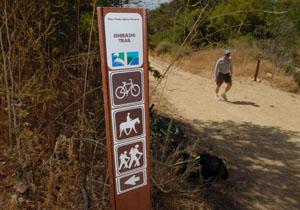
Ishibashi trail is open to all users, but cyclists are barred from the wide
Ishibashi Farm trail, which they argue can accommodate more use. (Steve
McCrank/Staff Photographer)
|
Under the new rules, the Grapevine, a Portuguese Bend trail beloved by mountain bikers, has been limited to horses and hikers. Two wide trails - Ishibashi Farm and Water Tank - that can accommodate multiple users more easily than most of the reserve's narrow paths have also been deemed off-limits for cyclists. And, because so many small spur trails have been shut down, paths that are shared among all three user groups will be more crowded, Braswell said.
"By closing so many trails, they've basically cut bikes out," Braswell said.
But some who have been critical of bikers aren't thrilled with the outcome either.
"There are no victories," Shaw said. "I will be happy when we see the trails being actually used properly."
The city is set to review the trails plan for Portuguese Bend Reserve in six months.
Fire Danger Level Being
Raised on the Angeles National Forest
 June 6,
2008 June 6,
2008
Arcadia, Calif.
– The Fire Danger Level on the Angeles National Forest is being raised
from “Moderate” to “High,” effective June
6, 2008 as summer temperatures continue to dry out vegetation and the
forest prepares for an increase in summer visitors. The “High” fire danger
level is the third in a six-level, graduated fire danger rating system. A
variety of factors determine the level, including the moisture in vegetation,
weather conditions and firefighting equipment needs due to national fire activity. Despite the change, there are no new
campfire restrictions: Open wood and
charcoal fires will still be permitted in developed campgrounds and picnic
areas only. Gas and propane powered stoves and grills are permitted in
non-developed areas with a valid California Campfire Permit.

Spark arrestors (required year-round) should be checked to
make sure they are in good working order on all off-road motorcycles, chain
saws and other equipment with internal combustion engines. Travelers through
the Forest should remain on designated roads and never park on dry brush or grass.
Visitors should also be reminded that some closures remain
in effect. This includes areas affected by the Ranch Fire (west of I-5) and the
Buckweed Fire (northwest of Hwy 14), including the popular Rowher Flat OHV area.
In addition, approximately 1,000 acres in
the vicinity of Cooper Canyon (north of the Angeles Crest Hwy) remain closed in
order to protect critical habitat of the Mountain Yellow-Legged Frog, a federally
endangered species. Williamson Rock, an area frequented by rock climbers, and a
portion of the Pacific Crest Trail lie within the closed area. Hikers can take
a detour around the area by departing the trail (northbound) at Eagles Roost
and taking the highway to Cloudburst Summit, a distance of 4.5 miles.
Contact:
Sherry Rollman or Stanton Florea at
(626) 574-5208“Know Before You Go” to the Angeles
National Forest. Find out about local conditions at your destination prior to
leaving by contacting the following offices:
- Forest Supervisor’s Office – Arcadia, (M-F
8:00 am to 4:30 pm) (626) 574-1613
- Los Angeles River Ranger District, (M-F 8:00 am to 4:30 pm) (818)
899-1900
- San Gabriel River Ranger District, (M-F 8:00 am to 4:30 pm) (626)
335-1251
- Santa Clara-Mojave Rivers Ranger District, (M-F 8:00 am to 4:30 pm) (661)
296-9710
Trail Race Is On – Trail in
Good Shape Thanks to Dedicated Volunteers
May 17, 2008
By Bill Coburn and
Pete Siberell, sierramadrenews.net
The Mt. Wilson Trail
Race is scheduled for Saturday, May 24th at 7:30am sharp. Though it
is the 42nd running of the race, it is the 100 year anniversary of
the first race, run by nine runners back in 1908. The men ran seven miles from
Sierra Madre up to Mt. Wilson, rested half an hour, then came back.
From 1912 to 1929,
there was no race, some say because the runners' interest was waning due to the
popularity of the automobile. Half-way between Sierra Madre and Mt. Wilson was
an orchard of apples, cherries, plums and chestnuts that soon became a public
resort known as "Orchard Camp." In 1930, the trail race was started
again to draw attention to Orchard Camp, and for the first time, the race was
expanded to include women and young girls.
The race was held
sporadically until the late 1940's when it was abandoned completely. It was
revived in the autumn of 1965, and over the years evolved to its present
format. In the spring of 1987, it was held in conjunction with Search and
Rescue Days. It has been run annually ever since, but this year, the Centennial
of the first race, it nearly wasn’t. The Santa Anita Fire closed down the trail
and did some major damage to the hillside on which the trail sits.
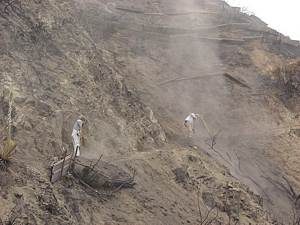 According to Pete Siberell,
chairman of the Mt. Wilson Trail Race Committee, the work literally started
while there were still fires on the mountain on Monday, April 28. A meeting of
the Committee was held in Kersting Court, and the members resolved to get the
trail ready in time to have the race go on as planned. “I received 15-20 calls
and emails on that day from people who wanted to help,” said Siberell. “The
first step was assessing the damage, which we did in short order right after
the trail was closed. The majority of damage occurred in a stretch less than a
mile-long, between the fire road just above the trailhead and the switchbacks
just short of First Water.” While there is significant damage on the ridge to
the east of the trail, the ridge on which the trail runs is relatively
unscathed north of First Water up to Orchard Camp, 3.3 miles up from the foot
of the Trail. According to Pete Siberell,
chairman of the Mt. Wilson Trail Race Committee, the work literally started
while there were still fires on the mountain on Monday, April 28. A meeting of
the Committee was held in Kersting Court, and the members resolved to get the
trail ready in time to have the race go on as planned. “I received 15-20 calls
and emails on that day from people who wanted to help,” said Siberell. “The
first step was assessing the damage, which we did in short order right after
the trail was closed. The majority of damage occurred in a stretch less than a
mile-long, between the fire road just above the trailhead and the switchbacks
just short of First Water.” While there is significant damage on the ridge to
the east of the trail, the ridge on which the trail runs is relatively
unscathed north of First Water up to Orchard Camp, 3.3 miles up from the foot
of the Trail.
Charlie
Bell, a long-time Trail
Blazer who
has tended the trail for many years, went up the trail numerous times with
other colleagues to assess its condition and to start grooming the trail. Peter McNulty,
Gary Hilliard,
Mark Gage, Mark Hacker, Pete Siberell, Brian Simms, John Grace and other CORBA
members and mountain bikers took part. According to Siberell “The work
was mostly clearing the “slough” made up of dirt and rocks that had fallen onto
the trail from above when vegetation burned up, and clearing dead vegetation.
It made for extremely grimy work, as clouds of dust came back in our faces from
below the trail. Although we were equipped with masks, we looked like coal
miners coming off the trail.”
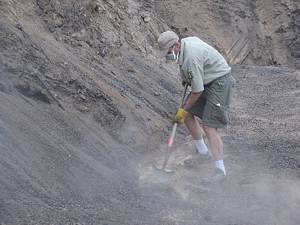 Some volunteers
worked on the trail during the day while it was still closed to the public, but
many came after completing their work day at their jobs, arriving sometimes at
6pm or later and working for an hour and a half or two until the sun went down.
A CORBA member who lives in Sierra Madre
put
together a volunteer team for last Saturday morning (May 10). With help and donations, he organized about 20
workers. The Department of Public Works lent tools, while the Only
Place in Town provided sandwiches, Starbucks sent beverages, and
Leanora Moss and Webb-Martin
Realtors provided cash for refreshments. Defending women’s champion
(and pregnant) Sharon
Pevsner delivered the sandwiches to the hungry workers. The workers not
only put final touches on the trail, but even worked above First Water on the
part of the trail that was not fire-damaged. Some volunteers
worked on the trail during the day while it was still closed to the public, but
many came after completing their work day at their jobs, arriving sometimes at
6pm or later and working for an hour and a half or two until the sun went down.
A CORBA member who lives in Sierra Madre
put
together a volunteer team for last Saturday morning (May 10). With help and donations, he organized about 20
workers. The Department of Public Works lent tools, while the Only
Place in Town provided sandwiches, Starbucks sent beverages, and
Leanora Moss and Webb-Martin
Realtors provided cash for refreshments. Defending women’s champion
(and pregnant) Sharon
Pevsner delivered the sandwiches to the hungry workers. The workers not
only put final touches on the trail, but even worked above First Water on the
part of the trail that was not fire-damaged.
Charlie Bell (who is the acknowledged expert on the
trail, based on his years of experience helping to maintain it), the world
famous Sierra Madre Search and Rescue Team,
and Pete Siberell with the Mt. Wilson Trail Race Committee had the final
say as to when the Trail could be re-opened to the public. Charlie assessed the
trail on Friday, May 9 and thought the trail should be opened as soon as
possible, for two reasons: first, so runners could familiarize themselves with
the new section of the trail and second, so that runners and hikers could tramp
down the trail as much as possible before the race, as it was soft in many
sections.
Jeremy Heiner, a Search and Rescue volunteer who is
also on the MWTR committee, declared the trail safe with some recommended
precautions. And Pete Siberell ran up and down the trail numerous times
to make sure the trail was race ready. Upon hearing those recommendations, the
city opened the trail the afternoon of May 9th and agreed with Siberell the
race would be run as scheduled, absent any mudslides occurring before then!
That doesn’t mean
the work is finished. Crews will continue going up to clear slough that will
have fallen on the trail between now and race day. Heiner and Siberell
will be going up the trail before race day to flag any spots still
considered dangerous for runners, and Search and Rescue plans to add another
eleven volunteers to the twenty he already had scheduled along the damaged
trail on race day so they can be ready to respond in case of a fall. And
finally, Siberell will be sending out emails to runners to caution them
about race conditions. He will also provide specific pre-race instructions
before the race begins on the morning of the race.
Said Siberell “As
with the way the community came together during the fire, it has similarly
bonded to bring the trail back to us, literally right before our eyes. The 100th
anniversary of the running of the Mt. Wilson Trail Race will take place,
right over the very mountain that was ablaze and had all of us in such anxiety
and suspense! But knowing the citizens and their love of volunteering and the
Mt. Wilson Trail, that is to be expected.”
The Committee
stopped accepting applications weeks ago, when the maximum allotment of three
hundred runners was met. Runners who want to check in early can come to the
Pasta Dinner event in Kersting Court on Friday night from 6P to 8PM. Runners
can pick up their race number and t-shirt early and have a great pasta dinner
from Cafe 322. Proceeds from the race will go to SM Search & Rescue. As a
bonus, John Robinson will be providing a history of the Mt. Wilson Trail
at 7:00P.
Spectators are
encouraged to come out Saturday morning, as there will be plenty going on to
entertain them while they wait for the competitors, friends and family to make
it back across the finish line. Kersting Court will be filled with booths from Elite
Fitness Boot Camp, New Balance, Patagonia, Jamba Juice, Kaiser, the Sierra
Madre Historical Society, and Train fitness center. Local singer/songwriter
Lisa Turner will be entertaining the crowds with her "Celtic-tinged
acoustic power folk rock." And for the adults this year, the Sierra Madre Rotary is
sponsoring a beer garden where folks can find a little post race refreshment.
Proceeds from the beer garden will be donated to the City’s Fire Fund. There
will be a Children's
Art Show co-sponsored by the Sierra Madre Community Arts Commission.
And at 8am, half an hour after the Trail Race start, the Third Annual Kid’s
Fun Run will take place for children three and up. The
Fun Run, sponsored by CATZ
(MWTR Committee's Jim
Liston is President) starts at the same starting line as the grown-ups’
race, and the kids run up Baldwin Ave. and back down to cross the same finish
line as the adults.
Siberell is planning
to put a sign up on the trailhead next week. It is on behalf of the Mount
Wilson Trail Race Committee, thanking the trail workers for their wonderful
efforts. The community is encouraged to come out on Race Day and show their
support, as well, for both the runners of the grueling race, and the volunteers
who helped ensure that this Centennial edition of the race is run.
Buy a Cell
Phone for Mountain Biking Access!
 May
19, 2008 May
19, 2008
(Note: As of March 2010, Phones for Good is no longer a viable
concern.)
CORBA has partnered with Phones
For Good. Phones For Good is an online retailer of cellular
phones dedicated to raising money for nonprofit organizations. PFG
offers a broad selection of phones and often, more competitive pricing
than traditional retailers. Many phones are free, and they are an
authorized Agent of AT&T, Verizon, Sprint, Nextel and T-Mobile.
When you buy a new cellular phone and plan through the Phones For
Good website and select CORBA, CORBA will earn $40.00 - $50.00 for
each new purchase. Check it out at http://www.phonesforgood.com/pfg/go/245.
Learn about other businesses
that will donate to CORBA when you use them.
Mustard
Growth on the New Millennium Trails in Calabasas
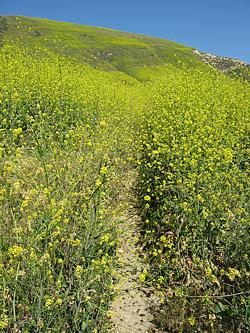 May
9, 2008 May
9, 2008
Spring has sprung and so did the Mustard plants! The New Millennium
Trail has become so overgrown with this plant the trail is unusable
at this time! The CORBA Trail Crew was out on 4/15 and 4/17 working
on the trail. It was a slow process but we managed to clear .7 of
a mile from the intersection of the Bark Park Trail heading south.
There is still much work to be done!
CORBA has been communicating with the Mountains Restoration Trust
(MRT)
to come up with a solution to get this great trail passable once
again! The MRT has mobilized their Crew to work on brush removal
on the trail. The CORBA Trail Crew returned to the trail on 5/9
and worked on some slides and erosion problems on the South side
of the trail near Normans Way.
The MRT Crew has cleared the brush from Parkway Calabasas past
Normans Way/Stokes Canyon to the switchbacks and Parkway Calabasas
towards Calabasas Road/Gun Club Road past the water tank on the
ridge above the other set of switchbacks.
We hope to be able to report very soon that the entire trail
is once again usable!
Web pages to check out:
December 7, 2008 Update: The
trails are completely clear of mustard and other weeds.
The Mount Hillyer Project
May 2, 2008
CORBA is pleased to announce the approval of our proposal for a new trail
in the Angeles National Forest. The new Rock & Rail Trail will be a 1 mile
long trail at the summit of Mount Hillyer near Chilao. It will include
many technical features. Read all about it on our Mt
Hillyer Project web page.
Bicyclist in trouble again over illegal trail at China
Camp
May 1, 2008
by Gary
Klien, Marin Independent Journal
A San Rafael man who built an illegal bike trial on
federal land in 2001 is in legal trouble again - this time for carving a trail
in China Camp State Park, authorities said.
Michael Philip More, 54, was charged Thursday in Marin Superior Court with
willful or negligent destruction or removal of plants and dead wood, diverting
or obstructing the natural flow of a stream, resisting a peace officer and
allowing a dog to roam off-leash in a restricted area, prosecutors said.
More is accused of digging an illegal bike trail into a hillside, hacking
down tree limbs and constructing rock paths through two drainage ditches,
authorities said. The quarter-mile trail is at the end of Robinhood Drive in San
Rafael's Glenwood neighborhood, which borders the state park.
The cost of repairing the damage is estimated at $20,000, said Kathryn
Mitchell, a senior county prosecutor.
Dave Gould, the superintendent overseeing state parks in Marin, said the
damage to the natural resources was "significant."
"It looks like chainsaws were used and trail-building tools to carve out the
hillside," he said. "This isn't where 15 people walked up and down the hillside
and you can see their path - this is an attempt to construct an illegal trail."
More, who could not be reached for comment, has pleaded not guilty. His
attorney, Patrick Ciocca, said More would be "loathe to engage in a public
discussion" about the allegations while preparing his defense.
"It would not be beneficial for him to enter into a public dialogue," Ciocca said.
Park rangers received a tip about the trail in March, when a resident noticed
unusual activity in the area. A ranger investigating the trail found More at the
scene, and More allegedly tried to flee.
More was cited, but not arrested, while prosecutors reviewed the case. He is
scheduled to be appear in court on May 9.
Alex Burnham, president of the San Rafael-based Access4Bikes advocacy group,
said he is concerned that the case will tarnish the entire bicycling community
and inflame tensions between cyclists and noncyclists. The issue of trail use
has fueled years of acidic conflict among hikers, bikers, equestrians and dog
owners, with the county sometimes resorting to barbed wire to block cyclists
from trails.
"We do not condone this behavior," Burnham said. "We advocate for legal
trails. É In Marin County, the trail user community is so polarized that
anything that occurs is a blight that gets thrown on the community of mountain
bikers."
More was once a prominent bicycling activist, serving on the Marin County
Open Space District Trails Committee. But he resigned the position in 2001 when
federal authorities accused him and two other men of carving a four-mile illegal
bike trail into the Golden Gate National Recreation Area near Bolinas Ridge.
All three men were indicted by a federal grand jury and eventually pleaded
guilty to misdemeanors. They were ordered to pay more than $34,000 in
restitution for the destruction to federal property, placed on probation for
three years and banned from the federal park system during probation.
They apologized in court.
Good News from
Palos Verdes
March 19, 2008
After the recent disappointment of the
Portuguese Bend meeting, mountain bikers in Palos Verdes really needed a
positive outcome. It came late Tuesday night at the Rancho Palos Verdes City
Council meeting.
Some speakers claimed that bikes destroy habitat and
endanger other users, and therefore should not be allowed on trails at the
Forrestal Reserve.
Fortunately, factual data in the city-ordered
Forrestal Monitoring Report supported our claims that bikes present no more
problems than other users. In fact, the report stated that there has not been a
single complaint against bikers.
As a result, the trails plan at
Forrestal remains intact with the exception of Cristo Que Viento, which was
changed to pedestrian. Bikers seldom use this trail because it’s incredibly
steep and goes into Rolling Hills.
It appears that the City Council is
beginning to grasp the needs of the entire community in this complex issue. Some
councilmen asked detailed questions from mountain bike speakers. One questioned
whether CORBA-PV could fulfill its promise to help educate local bikers. Yes, we
can! Now It is up to everyone who rides in Palos Verdes to ride responsibly and
continue to volunteer for trail work. These are the keys to more trail access
for bikes.
After being disappointed at last meeting’s results for
Portuguese Bend, we feel rejuvenated. We owe a big thanks to the eight resolute
bikers who came to the meeting. You rose from the ashes to fight again. You are
all heroes here! Thank you.
Economics and
Benefits of Mountain Biking
March 5, 2008
(updated March
14, 2008)
IRVINE, Calif. -- Enjoying the outdoors is as natural as riding
a bike and Shimano American Corporation and the International Mountain
Bicycling Association (IMBA) have teamed up to promote how important
the activity is. Shimano is a major manufacturer of bicycle components
and IMBA is a national advocate for responsible riding and trail
construction. Together they are releasing the new document, The
Economics and Benefits of Mountain Biking at the National Bike Summit
in Washington D.C. March 4 – 6, 2008.
More than 1 in 5 Americans age 16 and over ride a mountain bike,
and contribute $26 billion annually to the American economy while
enjoying the sport. Kozo Shimano said, “We want legislators, policy
makers and the public to understand how significant mountain biking
is to both the economy and to keeping people healthy.” One recent
cost benefit analysis concluded that every dollar invested in trails
led to almost three dollars in direct medical benefit. The World
Health Organization recommends riding a bike to reduce the risk
of cardiovascular disease.
Mountain bikers are also dedicated conservationists who volunteer
their time, labor and money to protect the natural and cultural
resources where they ride. IMBA Executive Director Mike Van Abel
commented, "From the beginning, IMBA members have embraced
a stewardship ethic that benefits conservation of our natural lands
and waters. This timely publication shows how that conservation
mindset also gives back with economic benefits."
Scientific research has shown mountain biking to be a low impact
environmentally sustainable activity with no more impact on natural
resources than hiking, and far less than many other recreational
activities.
Kozo Shimano added, “To put the activity in perspective, 50 million
Americans ride a mountain bike – more than 1 ½ times the
number of people who play golf. “
Copies of The Economics and Benefits of Mountain Biking can be
obtained from IMBA by sending a request to info@imba.com.
March 14, 2008: You can view the report by clicking this link:
 The Economics and Benefits of Mountain Biking The Economics and Benefits of Mountain Biking
CORBA Website
has a new look
March 4, 2008
The CORBA web site has been revamped to make it easier to find
information on mountain biking in the LA area! Stop back from time
to time to look for new features.
If you have comments or suggestions, please pass them along to
trailsmaster@gmail.com
City of Los
Angeles Bicycle Master Plan Meetings
March 3, 2008
In late February-early March, the City of LA held a series of
meetings to discuss the 2008 Bicycle Master Plan update.
The meetings were very informative and it appears that the City
of L.A. is doing things the right way. One great thing we
learned is that the new plan will include off-road bicycling and
two meetings in June and August (dates TBA) will be held for feedback
on off-road access and issues on City properties.
A brief introduction was followed by a fairly thorough Powerpoint
presentation outlining some of the challenges and options the City
is facing/considering. Alta
Design is the group doing the plan. Their staff includes riders
and bike commuters, cyclocross racers, and urban planners, with
some big city planning projects already under their belt.
The room was lined with easels outlining the major goals of the
plan, along with excerpts from other successful city bicycling plans
from around the world that are being considered for inclusion. There
was also a map outlining the current draft proposals, which looked
promising. Many of the existing bike paths to nowhere are shown
as being linked to other arterial routes and bike paths, along with
many new class II (bike lane) routes, and class I (bike path) routes.
The maps and all the information are available at http://www.labikeplan.org.
Please take the Bicycle survey to provide input ASAP. They
also link through to bikely.com
and suggest people create routes and submit them with comments and
suggestions for improvements. If there's a route you ride or would
like to ride, go ahead and get it considered. They're taking
feedback for the next six weeks or so, and will then be out in the
field taking measurements and doing traffic studies.
The plan is due for completion early next year, but of course,
then it all comes down to funding. So if you live in, ride
in, or commute in L.A., it's worth seeing the proposals and making
sure your needs are covered.
We'll definitely be attending the off-road meetings in June
and August where we'll likely face a barrage of opposition from
Griffith Park equestrians...so a show of numbers is going to be
helfpul.
Truce Called in Palos
Verdes Trails Controversy
February 25, 2008
From
The
Daily Breeze Online
By Josh Grossberg, Staff Writer
Horse enthusiasts and bicycle fans are going to have to learn
to get along - or at least tolerate each other - under a plan approved
Saturday by the Rancho Palos Verdes City Council.
After hearing from nearly a hundred speakers during a daylong
session, the council voted 4-1 to reopen the 420-acre Canyons Ecological
Reserve to both four-legged animals and two-wheeled conveyances,
with only Councilman Peter Gardiner voting against the proposal.
When the trails will open, however, remains in question.
First, trail signs must be posted, educational material prepared
and an enforcement plan put in place. It could be months before
any of that happens.
And another thing: The park isn't called Canyons Ecological Reserve
anymore. Earlier in the day, council members voted to change the
name to the Portuguese Bend Reserve. They also agreed to change
the city's entire 11,000-acre chain of wilderness areas from the
Portuguese Bend Nature Preserve to the Palos Verdes Nature Preserve
to avoid any confusion for visitors.
"The minute you step into Torrance, nobody's heard of it,"
Councilman Tom Long said of Portuguese Bend.
Four other less controversial trail plans also were approved.
With four more to go, the council decided that after nine hours
of discussions it had had enough and voted to postpone further talks
until next month.
So many people showed up to the meeting at the Point Vicente
Interpretive Center that a television had to be set up outside,
and people watched under a steady late-afternoon drizzle.
Although the council conceded that adjustments will probably
have to be made, the new plan calls for horse riders and bicyclists
to share many of the winding trails.
Other paths can be used by horses, but not bikes. Bikes can use
some, but not horses. And hikers get to use all of them.
"We should open it up to all users, provided it's safe,"
Gardiner said.
The majority of the speakers were horse riders who said that
while most bicyclists are courteous, many ride down hills too fast,
take turns dangerously and generally spook the horses. They also
complained that bicycles are eroding the terrain and destroying
plants.
"They do what they want when they want," one speaker
said.
It was a refrain heard dozens of times during the day. Horseback
riders acknowledged that bike riders had a right to enjoy their
hobby. They should just do it somewhere else.
"The only part of nature they enjoy is gravity," said
Rancho Palos Verdes resident Judy Herman.
But bike riders said that while there will always be reckless
people, most of them are well-behaved.
"There will always be people who don't follow the rules,"
said Rancho Palos Verdes resident George Hicks. "Embrace the
responsible user."
In the end, most people seemed satisfied with the truce - at
least for now. And as Mayor Doug Stern reminded everybody more than
once, figuring out how to share such a beautiful piece of real estate
isn't exactly the biggest problem in the world.
"This is a wonderful position to be in," he said. "You
all go out victors no matter what."
Palos Verdes Trails Access
Feb 19, 2008
Your presence is urgently needed Saturday
Feb 23rd, 2008
Rancho Palos Verdes City
Council to Decide
Trails Uses
This will be your last
opportunity to express your views on the trails plan
Where: Point Vicente Interpretive Center
Community Room located at 31501 Palos Verdes Drive West (Map)
 When: Saturday Feb 23rd 9:30 AM
meeting may last all day. Here is the suggested schedule. When: Saturday Feb 23rd 9:30 AM
meeting may last all day. Here is the suggested schedule.
Why:
Council will review
and consider the Public Use Master Plan (PUMP) Committee’s recommended Trails
Plan.
● View PUMP Committee trail recommendations for all
reserves here.
●
View CORBA PV trail recommendations for all reserves here.
You
can view the full Planning
Commission Staff Report with maps, minutes from the PUMP meetings, comments
from committee members, and letters from the public.
What other groups
recommend - Equestrian
10-3-07 , SUN'P Phase II
10-3-07
You can
participate by speaking (details
on speaking) and /or sending an email to the city council at CC@rpv.com. We
encourage RPV residents to voice their views. Email CORBA PV at info@mtbpv.org if you have
questions.
Suggestions:
- Please don't send duplicate emails or petitions, make them original.
- Keep it positive! No need to rant or complain, just tell them what you
feel is a fair plan.
- For specific trails, use the names on the CORBA PV
recommendations.
- For trails not on the map, try west or east of the
closest named trail. There should be a map on display.
Below are some points
to consider:
- Cyclist will stay on
designated trails and not build new ones.
- Cyclists will volunteer to
repair damage to trails.
- The bike community is working to make sure everyone
knows the rules.
- There is no evidence that bike use impacts trails
any differently from other users if they stay on designated trails.
- Cyclists have volunteered for trail work and deserve
respect.
- I've volunteered to repair these trails. We deserve
to ride them.
- Cyclists can control their bikes even on the
steepest trail.
- I've never had a bad encounter with hikers or
horses.
More information is available from the CORBA
Palos Verdes web site.
Use Goodsearch.com to
help CORBA
 Feb 18, 2008 Feb 18, 2008
Goodsearch.com is a grassroots search engine that donates a small amount
(1-2 cents) to a charity of your choice each time you search. If even just 100
people use Goodsearch.org twice a day, that's about $730 raised for CORBA per
year. The search engine that goodsearch.org uses is Yahoo. You can also click
though their GoodShop affiliate program when you shop online with participating
retailers for additional donations to CORBA or another charity of your choice. It's easy
to use. Once connected to http://www.goodsearch.com,
simply enter CORBA into the box where it asks "WHO DO YOU GOODSEARCH FOR?"
Check it out!
 March
27, 2008 Update March
27, 2008 Update
Now you can also use GoodShop
to help CORBA! Do your online shopping at more than 500 stores
through GoodShop and they will donate a few percent to CORBA.
Don't forget to specify CORBA as the group you goodshop for.
Learn about other businesses
that will donate to CORBA when you use them.
Stunt High Trail
Feb 8, 2008
Updated Feb 15, 2008
CORBA has received complaints
about irresponsible Mountain Bikers on the Stunt High Trail. The trail is
located in Stunt Ranch off of Mulholland Highway a few miles west of Old Topanga
Road. This trail runs through Mountains Recreation Conservation Authority
(MRCA), Mountains Restoration Trust (MRT) and University of California Reserve
land. This trail is used as part of an outdoor education area for young kids to
learn about the Native Americans, Plants and Animals.
On 1/27 a group
of five riders came down the trail. Four of the five riders were considerate and
slowed down as they passed a group of instructors and young kids on the trail.
One of the five riders did not slow down at all. The report is that he was out
of control and yelled to the group to get out of the way! He nearly missed
individuals in the group as he sped passed. After he passed the group he
crashed! This apparently was not the first incident like this on this trail.
Although this trail has probably been ridden by many riders for years it did
not become an issue until this incident. Remember your actions on the trail
affect us all!
On Thursday 2/14 we met with the managing authorities for the Stunt High
Trail. The outcome of the meeting is not good for Mountain Bikers. The trail
will remain closed to Mountain Bike riders! "No Bikes" signs will be
installed and MRCA Rangers will patrol and issue tickets to anyone riding the
trail! All UC Reserve land is closed to bikes due to its Reserve status. We may
have been able to convince the MRT to open their part of the trail to bikes but
it is such a small section of the upper trail that it would not have meant much.
Other options such as a reroute around the reserve or a new trail in the area
were also discussed. A reroute around the reserve will not work due to private
property outside of the Reserve land and steep rugged terrain.
Please
only ride on trails that are open to bikes. Always control your speed and your
bike. Scan the trail ahead for other trail users and animals. Use a bell to
alert others of your presence! Bicyclists yield to hikers and horses.
Albertsons'
Community Partners Program
Note: We learned in early
2010 that Albertson's has discontinuted this program. You can still
help CORBA when you buy groceries by signing
up for Ralphs' Community Contribution Program and shopping at
Ralphs!
 January 30, 2008 January 30, 2008
CORBA is pleased to announce
that we are part of the Albertsons' Community Partners Program. Albertsons grocery
stores contribute to your favorite participating 501(c)(3) non-profit when you
use your club card. All that you need to do is click on this link to sign up,
and use our Community Partner ID# 49001015710. http://www.albertsons.com/cp/
Sign-up now! It's quick and easy.
Learn about other businesses
that will donate to CORBA when you use them.
California State Parks Budget Crisis
Threatens Mountain Bike Access
Jan 27, 2008
Governor Schwarzenegger's plan
to combat California's projected budget crisis includes across-the-board program
reductions, including many cuts to the state parks department. The new proposal
would close 48 parks, including popular destinations like Henry Coe and Topanga
Canyon.
California State Parks has been victim to several significant
budget reductions in past years and the new plan would seriously imperil the
agency's ability to serve Californians, including more than five million
mountain bikers.
Take Action!
Send
a message to the governor and your representatives!
Tell
the Governor and your state legislators that these proposed closures are
unacceptable.
Why the Governor Should Spare State Parks
Millions
of Californians rely on State Parks for their main source of recreation. At a
time when health and obesity are major issues for California citizens, parks are
a viable resource that contributes to mental and physical health.
The
California State Park System is one of the best in the nation. The proposed
budget cuts, on top of significant past reductions, will further jeopardize
stewardship of the state's precious natural and cultural resources.
In
comparison to other departments, State Parks has an extremely small budget and
therefore a reduced capacity to absorb cuts. The Governor's plan calls for a
$13.3 million reduction, but this will close 48 parks and reduce seasonal staff
hours by 50 percent.
Ralph's Community Contribution Program
 
Jan 24, 2008
CORBA is pleased to announce
that we are part of the Ralphs Community Contribution Program. Ralphs grocery
stores contribute to your favorite participating 501(c)(3) non-profit when you
use your club card. All that you need to do is click on this link to sign up,
and use our "NPO" number 90320. http://www.ralphs.com/ccprogram.htm
Sign-up now! It's quick and easy.
Learn about other businesses
that will donate to CORBA when you use them.
City of Glendale Trails Master Planning
January 10, 2008
The City of Glendale has approved its Trails Master Plan. The City of Glendale covers part of the the east end of the Verdugo Hills, The west end of the San Rafael Hills and all of Deukmejian Wilderness Park.
CORBA has been and will remain involved in this planning process.
The Trails Master Plan was presented to the Glendale Parks and Recreation Department on November 7
and to the City Council a few weeks later.
Funding for the varius projects will need to be obtained.
The proposal includes a Mountain Bike Skills park and several new trails.
Man Allegedly Dug 50 Holes On
Trails
Jan 5, 2008
Revenge was not sweet for a man
who allegedly admitted digging holes on bike trails in a Fullerton park as
payback for nearly being run down by a mountain biker. He has been charged with
felony vandalism, police said Friday. Warren John Wilson, 52, faces a single
felony count of vandalism, said Fullerton police Sgt. Linda King. Wilson, who
could not be reached for comment, remains free on his own recognizance pending a
court date that has not yet been set, according to King. Holes began appearing
in mid-June on a trail popular with mountain bike riders that runs parallel to
the city's Bud Turner Trail at Laguna Lake Park at Euclid Street and Laguna
Road. About 50 of the holes have been found since June, all dug across the path
so that they would pose an obstacle to bicyclists. The holes measured about 1
foot by 2 feet, King said. Tree branches and brush were often placed along the
trail, as well as across the trenches in what seemed an attempt to hide them,
King said. Some riders reported that they were thrown over the handlebars after
hitting the holes, but no major injuries have been reported, she said. A park
ranger reported the holes to police, who periodically did surveillance in the
area. Detectives checked the trail after a man walking a dog was spotted, and
vandalism was found, King said. On Dec. 11, the same man with his dog was seen
entering the trail and leaving it 15 minutes later, and a later check showed
holes covered with a large piece of concrete and a branch, King said. When
questioned by police, Wilson allegedly said that he had "almost been run over"
by a bike rider once and, in retaliation, began digging the holes and placing
obstacles on the trail, King said.
Mountain Biker Input Results
December 12, 2007
Should mountain bikes be
allowed on trails or do such bikes do too much harm to the environment? That was
the question asked by the South Bay Daily Breeze. 17 of the 20 letters printed
were in favor of Mountain Bikes on the trails. See the following
link: http://www.dailybreeze.com/editorial/ci_7717296
Palos Verdes
November 7, 2007
CORBA has a very active group working on the trail access issues in Palos Verdes. Please see our separate site that is dedicated to the Palos Verdes area.
CORBA Palos Verdes Home
Call to Action: Sycamore BMX Bicycle Park to be soldOctober 18, 2007
HOW TO LEARN MORE The
R.S.R.P.D. has contracted with Hogle-Ireland Consultants to post a Sinaloa Park
website to inform the community and to receive input as to "What's Wanted in
Simi Valley" We encourage you to check the www.SinaloaPark.com website to get
"involved", understand the proposed project and give thought to fully evaulate
the impact that will be imposed on Simi Valley and the Citizens of this
community . . . Also see:
http://www.sinaloapark.info/BMX_Bicycle_Park.html
Trail User Survey
October 2, 2007
CORBA is pursuing new multi-use trail opportunities with several land management agencies in the Los Angeles and Southern Ventura County areas. CORBA solicited your feedback on the type of trails you enjoy most.
The Trail User Survey is now closed. We would like to thank everyone that took
the time to fill out the survey! The results from the Survey will certainly
help in our efforts to bring new riding opportunities to the Los Angeles area.
Also a big thanks Cole Wheels for donating the wheel set which was won by one
lucky survey participant!
View the survey results
Fire Breaks
August 8, 2007
The City of Los Angeles Fire Department’s Special Operations Division and the Santa Monica Mountains Conservancy noted that the current fire potential is extremely high and unprecedented. The LA City Fire Department Special Operations Division, with the permission of the Conservancy, took “fire life safety” actions to protect the community from wildfire this coming season. The Fire Department’s goal was to re-blade pre-existing fuel breaks (ridges) that run perpendicular to the northeast Santa Ana winds to a width of at least 50 feet wide. While we warmly refer to them as ridges, the fire authorities cut them decades ago to serve as fuel breaks, yet they have not been re-bladed in approximately 20 years. Should fire occur, a DC10 will be flown along the fire-side of the ridges and drop a swath of fire retardant 1/4 mile long per each pass. Fire crews and helicopters will be positioned to fight fire on the leeward side of the fuel breaks, if it is deemed safe.
The ridges that were re-bladed were Kenter Ridge, East and West Mandeville ridges, Westridge and Sullivan Ridge. Per the Fire Department, those are the only ridges that are being “re-bladed.” Only ridges that are, according to the Fire Department, pre-existing fuel breaks, were bulldozed. Trails adjacent to the ridges, such as the Whoops, were not and will not be touched. The Assistant Fire Chief would not commit to including community groups such as CORBA in the fire life safety planning process. While CORBA is not in the business of fire prevention planning and we have no intention of interfering with fire prevention efforts, we are in the business of saving trails. We have requested to be contacted prior to future work projects and that such projects be posted so trail users are aware of what and why a project is being done. We believe that trails can be preserved while authorities accomplish their goals of fire protection.
Jul 20, 2007 The Mt. St. Mary’s Trail is
now being realigned and has been renamed the “Nancy & Dick Riordan Trail.”
The trail will be completed in, approximately, November 2008. Until then, the
Trail will be closed to the public due to construction hazards. The Riordan
Trail, however, has already been officially dedicated by the Santa Monica
Mountains Conservancy and half of the new trail has been constructed. For more
information go to www.canyonback.org
Santa Susanna Pass
May 8, 2007
The State of California is currently in the General planning process for this fairly new State Park. The plan calls for some of the existing trails to be closed to all users, some trails will be open to hikers only. The Old Santa Susana Stage Road may be closed to Mountain Bikes due to its Historic Status. There are also some trails near Oakwood Memorial Park that the Park Service may be considering closing to bikes and Horses to protect cultural resources.
We need your input. For more information, please go to the State Parks Site and check out Preferred Plan on the right side of that page. This is a PDF map of the area and it shows the trails. If you ride this area and know of trails that are not on the map (if they are not on the map they may be closed)and you feel they should remain open for Mountain Bike use or have other feedback, CORBA would like to hear from you. Please contact Hans with any feedback or concerns.
Mountain Bikers Retain Trail Access in Southern California Forests
April 30, 2007
The most extensive formal appeal in IMBA's 19-year history has culminated in an agreement that will maintain widespread bicycle access in four National Forest units in Southern California. With hundreds of trail miles at stake in the Angeles, Cleveland, Los Padres and San Bernardino forests, bike advocates embarked on a lengthy appeals process to a Forest Service decision to close dozens of trails to bikes.
The decision was the culmination of five years of mountain biker participation in the Forest Service planning process. "Even when the documents and alternatives didn't favor us, the Forest Service staff welcomed our participation and encouraged us to keep working toward a solution," says IMBA Rep Jim Hasenauer, who began working on the issue in 2001 when the four forests first announced a joint planning process for trail management.
According to IMBA California Policy Advisor Tom Ward, strong partnerships with state and federal agencies hold the key to bike access throughout the state. "IMBA's approach to mountain bike advocacy is to build strong relationships with land managers throughout California. We promote quality riding opportunities and work hard to create fun, environmentally sustainable trails that all users can enjoy," says Ward.
IMBA Filed Extensive Appeal
In 2004, after three years of preliminary work, the four Southern California forest units jointly released alternative plans for forest and trail management. IMBA's action alert generated hundreds of messages and letters urging that trails be kept open to bikes. "Although there was much that we liked in the original plan, we had concerns about some of the proposed Wilderness areas, the treatment of bicycles in 'critical biological zones,' and the ambiguity of language regarding bicycle use only on formally designated 'system' trails," says Hasenauer.
In 2005, the forests issued a revised plan that addressed most of IMBA's initial concerns. New Wilderness additions would have little effect on mountain bike opportunities, bikes would be allowed on trails in the "critical biological zones" unless specifically prohibited, and the Forests promised to deal with the "unofficial" trails issue with public participation, over time.
In Oct. of 2006, the San Bernardino National Forest indicated its intention to close all "non-system trails" to bicycles. "We felt that was inconsistent with the 2005 plan," says Hasenauer. The Forest disagreed, but met with local bicyclists to inventory and keep some of those trails open. The local mountain biking community stepped up to help the Forest identify important trails for mountain bikes and the Forest agreed to delay the closure.
At the same time, Hasenauer worked with fellow IMBA Rep Daniel Greenstadt, IMBA's Gary Sprung (then Senior Policy Adviser, now an independent contractor) and Washington-based policy advisor Kirk Bailey to develop an official appeal. "The appeal was the most extensive public participation document that IMBA has ever developed," says Hasenauer. "Most appeals are quickly disqualified, but ours went forward."
Meetings Lead to Withdrawal of Appeal
In Nov. 2006, Hasenauer met with the Southern California Forest Supervisors and staff. "We agreed that the three other forests had a more reasonable approach and we're in fact, a more reasonable interpretation of the new plans," says Hasenauer. "We agreed that there would need to be a process and a Forest Order before trails were closed. Bicyclists could continue to ride such trails unless specifically prohibited. They also indicated that generally if non-classified trails were to be closed, they should be closed to all users." That understanding resulted in the December 2006 withdrawal of IMBA's appeal.
"This is a great example of how steadfast advocacy inside public participation processes can save trails. IMBA is quite satisfied with the resolution and we look forward to working with the Forest Service on trail management issues again," says IMBA Government Affairs Director Jenn Dice.
For more information, Contact: Mark Eller, Communications Director,
markeller@imba.com, 303-545-9011
National Park Service Listening Session
March 29, 2007
The National Park Service hosted a Listening Session at the Museum of Natural History in Los Angeles. With the Centennial of the National Park Service approaching in 2016, the agency hosted Listening Sessions nationwide to hear from the public to help craft a vision for the next century. NPS Superintendents from all over the Western United States including the Western Regional Director, Jon Jarvis, and many NPS rangers and managers were in attendance to facilitate discussions and take public input back to be compiled and presented to the White House as part of the Centennial Initiative, a ten-year plan to invigorate national parks and prepare for the next century. The Centennial Initiative provides $100 million per year to the NPS above and beyond the annual budget for investment into the National Park system. There is also a provision of up to $200 million per year additional funding, whereby the federal government will match philanthropic donations of up to $100 million to the NPS for signature projects.
 Three main questions were asked by the NPS including: what are your hopes and expectations for the future of National Parks; what role should the National Parks play in the lives of Americans and visitors from around the world; and what projects and programs would you like to see completed. Despite these questions, a handful of anti-mountain bikers were in attendance suggesting that mountain bikes not be a part of the future of our National Parks. Fortunately, CORBA board members Jeff, Louisa and Gary were there to add balance to the discussion, provide input and also note how successful multi-use trails are in our local National Parks (i.e., Cheeseboro) as well as the amazing experiences that are available at parks such as Joshua Tree and Chaco Canyon. Three main questions were asked by the NPS including: what are your hopes and expectations for the future of National Parks; what role should the National Parks play in the lives of Americans and visitors from around the world; and what projects and programs would you like to see completed. Despite these questions, a handful of anti-mountain bikers were in attendance suggesting that mountain bikes not be a part of the future of our National Parks. Fortunately, CORBA board members Jeff, Louisa and Gary were there to add balance to the discussion, provide input and also note how successful multi-use trails are in our local National Parks (i.e., Cheeseboro) as well as the amazing experiences that are available at parks such as Joshua Tree and Chaco Canyon.
We also shared our vision for a National Parks system with more opportunities for responsible mountain bicyclists. Bikes get people out of their cars and into the parks. Mountain biking is a sustainable, low-impact, human-scale form of recreation that is healthy for individuals, families and communities. We know from our experience in the Santa Monica's and other National Parks that bikes belong. We thank the National Park Service for hosting the Listening Sessions.
|


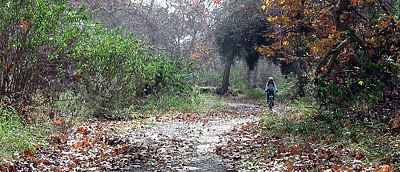 Grade a 12 foot wide road with wider
turn-outs all the way up Sullivan Canyon from Queensferry
to Mulholland;
Grade a 12 foot wide road with wider
turn-outs all the way up Sullivan Canyon from Queensferry
to Mulholland;