Posts Tagged ‘backbone trail’

CORBA Meets With State Parks Superintendents

Wednesday, December 1st, 2010

On November 22 CORBA Board of Directors members Mark Langton, Hans Keifer, Danusia Bennett-Taber, and Steve Messer, along with IMBA representative Jim Hasenauer, met with Topanga Sector Superintendent Lynette Brody and Acting Angeles District Superintendent Craig Sap. The specific purpose of the meeting was to update Superintendent Sap on CORBA’s programs as well as to review the trail conversion request made by CORBA more than two years ago as part of a state-wide process.

Several key points were brought up during this meeting:

-CORBA programs (trail work and maintenance, Youth Adventures and CORBA Kids Club, Skills Classes) and their positive value and impact on the trail user community.

-Mountain bikers, despite representing a large percentage of overall trail users, have the fewest miles of singletrack trails available. Mountain bikers, based on numbers and skill levels, deserve a diversity of experiences (beginner, intermediate, advanced) the same way that hikers have access to a wide variety of trails, as well as equity of experience that our numbers justify. We also stressed connectivity as there are many missing links and places where bicyclists are cut off from important destinations.

-Trails currently closed that should be designated as shared use: Backbone Trail segments of Musch, Topanga to Malibu Creek, Ray Miller, Paramount to Malibu Creek (Lookout or Yearling, Topanga SP to Temescal Gateway Park, Temescal to Rogers State Historic Park; other trails currently closed to mountain biking including Rustic Canyon from Mulholland and from Rogers Road, Los Liones, Bent Arrow, and Garapito trails in Topanga SP, Nicholas Flats Trail in Leo Carillo SP, Hidden Pond and Coyote trails in Point Mugu SP.

-We were frustrated at recent actions that seemingly ignored our concerns while almost concurrently created diminished opportunities and conditions for not only mountain bikers, but all trail users.

-Current status of the trail conversion process in the Angeles District.

While this meeting was in some respects a new beginning with State Parks leadership, Superintendents Brody and Sap were both very familiar with CORBA in general, and there was certainly an air of cooperation that we have not experienced in several years. Said Superintendent Sap in a follow-up email response, “I feel yesterday’s meeting was very productive. I came away with a greater appreciation of CORBA and feel encouraged that we can move forward with a renewed atmosphere of mutual respect and understanding.” CORBA’s feeling is that there is an improved sense of commitment and enthusiasm from State Parks management, and that they comprehended our points about equity, diversity, and increased opportunities. In particular, we were assured that direction by trails experts at the State level will be weighted heavily in the conversion process, and that the public will have opportunities to submit input. We were also told that management recognized that recent actions that effected trail conditions and access were not handled appropriately in respect to informing the public, and that greater efforts would be made to fully educate the trail user community of impending actions moving forward.

The current status of the conversion process is ongoing, with trails in Topanga State Park taking priority as part of the current development of a trail plan in that park. On December 15 the use status of Musch, Lookout, Yearling, and Deerleg Trails will be discussed by State Park personnel and an announcement will follow shortly.

Rogers Road Trail Update

Monday, November 15th, 2010

On November 10, CORBA Board members Mark Langton, Jeff Klinger, Hans Keifer, Danusia Bennet-Taber, and Steve Messer, along with Jim Hasenauer of IMBA and Bryan Gordon of the Canyonback Alliance, walked/rode the upper section of Rogers Road Trail with Topanga Sector Superintendent Lynette Brody and Maintenance Supervisor Dale Skinner.  This tour was arranged by CORBA with these State Park employees in response to intense public input regarding recent work performed on the “re-route” (singletrack) section of trail (west where it meets Temescal Ridge Fire Road) as well as about a mile and a half of the wider road bed to the east of the singletrack. In the past few weeks, Supervisor Skinner has used a Sweco trail tractor/dozer to fix and install several drainage channels, as well as bring the trail up to vegetation clearance guidelines for multiple use, specifically, equestrians. Many local trail users have complained to State Parks that the work was overdone and that a once narrow, serene singletrack trail has been obliterated into a road.

There are actually two separate sections, the “re-route” which was built as a true narrow trail, and the main Rogers Road Trail, which was originally a road cut that supported wide and heavy equipment.

Earlier comments on CORBA’s web site began by trying to assuage concerns of trail users not familiar with this kind of work by saying that typically trails “come back” to a more natural state after a couple of seasons. This can be said for the “re-route” section, although CORBA noted to Supervisor Skinner that the widening created a “faster trail” and suggested that possible speed control devices such as pinch-point structures be considered.

As for the wider section, based on the tour that took place on November 10, CORBA’s original comments were premature. After witnessing the complete section of the work area and hearing comments made by Supervisor Skinner, as well as an evaluation by professional trail contractor Hans Keifer, it is evident that the work that was performed lacked forethought and consideration for minimal impact. In fact, no Project Evaluation Form (PEF) was submitted for this work and therefore is in direct violation of the department’s own policy. We were assured by both Superintendent Brody and Supervisor Skinner that the work will not continue until a Project Evaluation Form is completed and that trail users will have a say in the process, which they said could take several months to over a year.

It’s true that after new construction or trail maintenance, trails look bare and lose their natural character.  Typically, Spring rains create new vegetation which helps the trails recover some of their more natural character.   This has been our experience on several agency trail maintenance projects in the past.  In the case of the recent work on the wider section of Rogers Road Trail there was a fundamental disagreement between the State’s position that Rogers should be maintained to “road” standards and that vegetation should be cut wider than the 8-foot wide/10-foot high vegetation clearance suggested by multiple use guidelines–and CORBA’s position that Rogers is a trail (the Backbone Trail), not a road; that the 8-foot/10-foot clearance was for new trail construction, not existing trails, and that the trail should be left as narrow and natural as possible while addressing and achieving the maintenance concerns of water drainage and a proper vegetation width for shared use with equestrians.

We acknowledged that this is a multi-use trail that must work for all users and that there are several drainage and maintenance issues that are beyond the scope of handwork.  We demonstrated how anything more than an 8-foot clearance wasn’t necessary for safety or sustainability and that in many cases the clearance that has been done was far wider than eight feet.  CORBA’s position is that this work went too far and urged State Parks to minimize the impact of the maintenance on the only bike-legal singletrack in Topanga State Park.

We were informed that the plan was to continue the work down to the Will Rogers State Historic Park Trail Loop, and we also expressed serious concern about continuing these impacts into what is admittedly an eroded and deteriorating section of trail. Superintendent Brody and Supervisor Skinner reiterated that moving forward, greater evaluation and a full PEF would take place and could take several months to over a year.

Examination of the new/refurbished drains that were installed shows minimal attention to corrected out sloping to facilitate proper drainage; drains were basically cut with only a few passes with the Sweco’s blade and very little additional shaping or contouring was evident. On another section of trail, an entire corner (approximately 250-300 square feet) was scraped clean of vegetation, with the reason for the denudation being “ it’s for the hikers. Hikers like the beautiful views.” This brush clearance ignores the fact that it created a large, bare, disturbed area of unprotected, easily eroded earth that will exacerbate hydro erosion because there is no root system to control runoff. Also, there was no drain installed at the bottom of the hill where water would run to from this bare area. Another section of trail further south was smoothed of ruts and out sloped correctly. However, the width of the tread was increased to approximately 12 feet, far more than what CORBA considers appropriate or necessary.
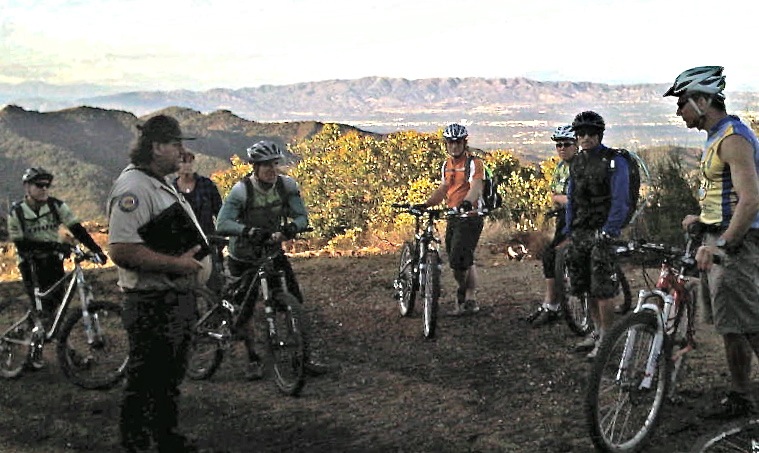
Maintenance Supervisor Dale Skinner (left foreground) and members of CORBA discuss the complete removal of vegetation from dozens of square yards of soil at an "overlook" section of Rogers Road Trail. Photo by Jim Hasenauer

Again, we were assured by both Superintendent Brody and Supervisor Skinner that the work will not continue until a Project Evaluation Form is completed and that trail users will have a say in the process. Check back here for further information as we get it. There will be several opportunities to get involved as trail planning in Topanga State Park and the rest of the Santa Monica’s moves forward. We encourage you to get involved with your parks’ planning process and be proactive in shaping park policy, planning and landscapes.

Trail Work on Rogers Road Trail Halted

Wednesday, November 10th, 2010

CORBA has learned that the recent trail work that has begun on Rogers Road Trail approximately two miles from Temescal Ridge Fire Road (western terminus in Topanga State Park) has been temporarily halted. This has happened in large part to intense input from the public and CORBA, and a request from CORBA for State Park officials to re-examine the necessity and scope of the work before continuing. We have been told by both the maintenance and ranger departments that officials have met internally and are reviewing the protocol and standards for this work. Additional meetings will be taking place this week to determine how and when additional trail work on Rogers Road Trail may take place. At this time it is unclear when the work will resume and at what level, and/or if it will continue the full length of trail to Will Rogers State Historic Park.

Please stay tuned to this web site for further updates.

Topanga State Park Meeting #2

Saturday, August 14th, 2010

On July 28, Jim Hasenauer and Jeff Klinger attended the second General Plan Meeting for Topanga State Park. It is important that riders weigh-in on this process and view the planning website at: http://www.parks.ca.gov/default.asp?page_id=25956.

Most of this meeting focused on the vision for the park and the idea of management zones. There are several important concerns for cyclists. Input at this phase of the General Plan process will be used to formulate the Preferred Plan. Please read the following, check out the website and comment at: enviro@parks.ca.gov

1. The plan emphasizes preservation of Topanga’s significant natural resources. We support that. Unfortunately, the vision does not give strong enough commitment to trail recreation in the park. The mission of California State Parks is: To provide for the health, inspiration and education of the people of California by helping to preserve the state’s extraordinary biological diversity, protecting its most valued natural and cultural resources, and creating opportunities for high-quality outdoor recreation. Topanga’s vision needs to be consistent with the agency’s mission. The Vision should include a statement such as: “Provide outstanding sustainable and diverse trail experiences for hikers, mountain bicyclists, equestrians and other park visitors.”

2. Mountain bicyclists have enjoyed Topanga since the very first days of our sport. One of the early mountain bike pioneers, Victor Vincente of America, developed his prototype “Topanga” mountain bike there. When CORBA was formed in 1987, it was partially in response to the closing of singletracks in Topanga State Park. Mountain bicyclists want equity of trail experiences, diversity of trail experiences, and connectivity of trails. The plan will influence each of these for many years, so it’s important that you submit comments now.

Equity of trail experience – If you ride Topanga, you know that on any given day, most of the trail users are on bicycles. In contrast, we’re only allowed on less than half the trails/roads. All singletracks, with the exception of Roger’s Road, are closed to us. It’s fine to have one or two singletracks “hiker only,” but it is not fair to have all but one of them closed. An early descriptive statement on the Planning web page says “singletrack trails host hikers and sometimes equestrians.” It’s time for this to change. Let the Park Service know which singletrack trails would be important to you. Ask them to open them. Another concern is that the park is considering “natural and cultural preserves.” In most cases, preserves ban bicycles. We are, of course, committed to protecting these wild and significant areas, but there should be bicycle access to and through these preserves.

Diversity of Trail Experience—Mountain bicyclists, like other outdoor recreationalists, are diverse in our interests and abilities. Topanga riders range from beginners, including children first learning to ride, to skilled, technical, even professional riders. The one size fits all view of “fire roads yes/singletracks no,” does not serve the public’s recreational needs. Our highest priority for the Santa Monica Mountains has always been access to the entire length of the Backbone Trail. In Topanga, Hondo Canyon and the Musch trail are sections of the Backbone that mountain bikers want open. In the planning meeting, they presented a “Visitor Based Camping and Trail Map” that shows the Hondo Canyon section of the Backbone open to bikes. We need to support that. It is true that not everyone could ride all of the Hondo Canyon trail without walking, but that doesn’t mean it should be closed to us. In fact, part of the experience of mountain biking is the adventure of exploring new trails and to hop off and hike-a-bike sections that are too steep or technical for our abilities. Land managers don’t seem to understand this concept, or mountain bikers in general. The Musch Trail is a significant missing link in all of their plans. There’s a trail camp there, which we need access to. The Backbone Trail is the most significant, long distance trail in the Santa Monicas. It should be open to us. The Plan also envisions a major trailhead for the Coastal Slope Trail, a long distance trail on the ocean side slope of the mountains. This too must be multiple-use.

Connectivity of trails – There are at least two major obstacles to connectivity in Topanga. The first is the cyclist missing link to the Backbone mentioned above. The second is bike access to Temescal Canyon. Over the last several years, Temescal Canyon has become the site of regular meetings, seminars, interpretive events, family activities, etc. Those of us coming from the San Fernando Valley side cannot get there by bike. That’s particularly frustrating because there are two trails that go from Topanga State Park to Temescal and one trail that goes from Will Rogers State Park to Temescal. All three of these are closed to us. The Visitor Based map indicates that the Temescal Ridge Trail would be open to bikes. This is significant and needs to be supported.

Vehicles on dirt Mulholland – State Parks is considering allowing cars to drive along dirt Mulholland in the Mulholland Corridor Zone (see map). We oppose this. Note that it does not have to be either “visitor based” or “preservation based,” it can be a mix of both.

It’s important that you let State Park officials know that you love Topanga State Park and have specific recreational needs there. We have seen the Angeles District of State Parks spend tax dollars on new “No Bikes” signage in Topanga and we’ve seen their employees attempt to re-designate Sin Nombre and two Foxes trails in Pt. Mugu to hiker-only (which CORBA literally caught in the act and prevented). Overall, they APPEAR to be biased against, and turning a blind-eye to the needs of the State’s residents who visit and recreate at State Parks via mountain bicycle. Well, State Parks is reaching out to the public for input and support. Let them know that you, as a State Parks visitor, supporter, and enthusiast, expect more from them, and equitable representation in this plan. Email comments to: enviro@parks.ca.gov or write: SOUTHERN SERVICE CENTER / Project Lead, 8885 Rio San Diego Dr., #270, San Diego, CA  92108-1627

Thanks,

Jim Hasenauer & Jeff Klinger

Backbone Trail Maintenance June 2010

Friday, June 25th, 2010

By Mark Langton 

Latigo Canyon section of the Backbone Trail just west of Newton Mtwy.

Over the last couple of weeks some new maintenance has occurred on the Backbone Trail along sections at Solstice and Latigo Canyons (National Park Service-held property). The crew that did the work is unknown at this time, but it is assumed that it was National Park Service or contracted by them.  It was very professionally done. Hand-worked tread leveling and minor widening has taken place, with a few sections being filled in with soft dirt. The depth of these short fill sections does not exceed one inch at their deepest. 

The trail heading east from Newton Motorway: Natural rock formations along the upper section and at the bottom as it enters the canyon bottom  have been left intact.  Switchbacks were left intact or filled slightly. 

Another section of the Backbone West of Newton Mtwy. where some rock was left in the tread.

The section of trail most affected is directly to the west of Newton Motorway. The tread surface of the first half-mile of this mildly rolling, somewhat technical section has been leveled and filled, and slightly widened, and three or four short rocky sections were removed, making it much less technical. Further to the west, where the trail has notoriously seen heavy erosion due to its steep pitch, it has been slightly re-routed and leveled, and several drainages have been added to assist with water runoff. This is a significant improvement for both uphill and downhill travel.  When contacted by CORBA, Melanie Beck, an outdoor recreation planner for the National Park Service, stated that the work was considered routine and done for resource maintenance and safety concerns. At the time of this report no information was available regarding any additional trail work in the immediate future. 

Over the last 23 years I have seen this type of trail work and it is indeed not out of the ordinary, nor is it overly aggressive (of which I have also seen). In fact, the soft sections of tread surface resemble that of a just-completed new trail. Compacting will take place over the next few months with use and moisture, and hydro-erosion will begin sculpting ruts and other natural formations. Climbing the filled sections was a little more work than usual, but they should get packed down soon enough. And descending required only slightly more attention paid to washing out. I am a little disappointed that the short rocky sections were removed, but that’s a personal selfishness—the trail is still a blast and is one of the best and most scenic sections in the Santa Monica Mountains National Recreation Area.