|
IMBA's
Rules of the Trail
1) Ride on Open Trails Only.
Respect trail and road closures (ask if uncertain); avoid trespassing
on private land. Federal and state Wilderness areas are closed
to cycling. The way you ride will influence trail management decisions
and policies.
2) Leave No Trace.
Be sensitive to the dirt beneath you. Recognize
different types of soils and trail construction; practice low-impact
cycling. Wet and muddy trails
are more vulnerable to damage. When the trailbed is soft, consider
other riding options. This also means staying on existing
trails and not creating new ones. Don't cut switchbacks. Appreciate
the parkland that we have and pack out what you pack in, and pick
up random litter.
3) Control Your Bicycle! Inattention for even a second can cause problems. Obey all bicycle
speed regulations and recommendations.
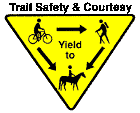
4) Always Yield the Trail to Other Trail
Users. Cyclists yield to equestrians and hikers. On trails, stop
and step aside if necessary to let them pass.
- Ring your bell before you approach so as to not startle
them.
- Scan the trail ahead for other trails users.
- Anticipate other trail users and ring your bell around corners
or in blind spots.
Yielding means slow down, establish communication, be prepared
to stop if necessary and pass safely.
For horses, stop and ask equestrians if it is ok to pass. Horses
are easily startled. Horses recognize the human voice more
so than bells. In general, if you meet an equestrian on a
trail,
- Stop and move to the downhill side to let them pass.
- Talk to the rider and respect how they prefer to pass with
their horse.
The rider will appreciate your courtesy.
When approaching other cyclists, the biker going uphill has
the right-of-way. This courtesy is extended to not break
the climber’s momentum and because it is easier to restart when
going downhill if there is a need for someone to stop for a safe
pass. Note that the person with the right-of-way can choose
their path. They may not follow the convention of staying to the
right if that is not their best path, even on fire roads!
How are you perceived by other trail users? Even if you
are a caring and friendly individual, with your helmet, sunglasses
and a facial expression concentrating on the trail, you may appear
intimidating to other trail users. Smile, say "Hi!" and
ring your bell if you have one. It will promote goodwill on
the trail and happiness to the trails community that we are a part
of.
5) Never Scare Animals. Animals are startled by an unannounced approach, a sudden movement
or a loud noise. This can be dangerous for you, others, and
the animals. Give animals extra room and time to adjust to
you. Running cattle and disturbing wildlife is a serious offense.
Leave gates as you found them, or as marked. For information
about rattlesnakes, click here.
6) Be Prepared and Plan Ahead. Having a successful ride depends on your preparation and knowledge.
Know your ability, skill level and equipment, and choose your trail
accordingly. Always wear a helmet, prepare your bike, take
a map
of the area where you will be riding and check
the weather. Bring enough water, snacks, and tools to
repair your bike, and take any necessary clothing. Be self-sufficient
so your ride is satisfying to you and not a burden to others.
7) Take the Opportunity to Give Back
to the Trails - The CORBA
Trail Crew. The local trails are valuable resources for you and the community.
The trails give us so much pleasure, but they also need some
TLC from time to time. When we see a rain-rutted or overgrown
trail, we may think that “they” will take care of it. But who are
“they” anyway? The park agencies don’t have the resources
to maintain the trails, so they rely on volunteer groups such as
the CORBA Trail Crew to come out and get our hands dirty. And
you know what, we have a great time doing so! We invite you to come
out and donate some time and muscle helping the CORBA
Trail Crew in building, repairing, and maintaining the trails
you enjoy so much. The CORBA Trail Crew works each month on
trails in LA and the surrounding area. For more information, check
the CORBA Trail Crew schedule on the calendar
or the Trail Crew page.
|
Guidance from trailetiquette.org
 Mountain Bikers, What
can you expect? Mountain Bikers, What
can you expect?
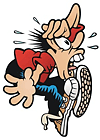
Surprised trail users. Fast-moving bikes
can startle others, especially when coming around
a blind turn or approaching from behind.
What is your responsibility?
 Mountain bikers yield to hikers, horses and uphill-riding
cyclists. Slow Down around other trail users
and anticipate people or animals around blind turns.
Consider using a bell to help avoid surprising others.
Be exceedingly friendly and communicative. On wider
trails and fire roads keep to the right. Always
ride under control and avoid skidding. Never put
others at risk. Mountain bikers yield to hikers, horses and uphill-riding
cyclists. Slow Down around other trail users
and anticipate people or animals around blind turns.
Consider using a bell to help avoid surprising others.
Be exceedingly friendly and communicative. On wider
trails and fire roads keep to the right. Always
ride under control and avoid skidding. Never put
others at risk.
Passing Hikers:
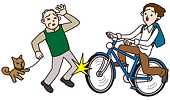 1. Greet hikers early with
a friendly "howdy" or "good morning." 1. Greet hikers early with
a friendly "howdy" or "good morning."
2. SLOW DOWN to about the same
speed as the hiker.
3. Pass slowly and be prepared to stop
if necessary. Others' perception of a safe, courteous
speed may be different to yours. Show your appreciation
if they step to the side for you.
4. Expect the unexpected. People
and animals can be unpredictable or easily spooked
or startled by cyclists.
Passing Cyclists:
 1. Announce your intention to pass with
a friendly "Let me know when it's safe to pass." 1. Announce your intention to pass with
a friendly "Let me know when it's safe to pass."
2. Use the "singletrack yield"
on narrow trails: the yielding rider should stop
to the side, put one foot down and lean both body
and bike away from the trail.
3. Give uphill riders the right of way
when you're going downhill. It's much harder to
get started again on a climb.
Passing Horses:
 1. Immediately slow down and stop at least
30 feet from the horse. 1. Immediately slow down and stop at least
30 feet from the horse.
2. Greet the equestrian and the horse.
Speaking shows the horse you are human and not a
threat.
3. Ask how or when to pass safely. Offer
to get off your bike.
4. Pass slowly and steadily, but only
after the equestrian gives you the go-ahead. Sudden
movements or noises can spook a horse. Where possible,
pass on the downhill side of the animal.
|
IMBA’S 10 Responsible Riding
Tips
- Be Prepared
- Don’t Ride on Closed Trails
- Say No to Mud
- Respect the Trail, Wildlife and
Environment
- Stay on the Trail
- Ride Slowly on Crowded Trails
- Pass With Courtesy and Care
- Share the Trail With
Other Trail Users
- Don’t Do Unauthorized Trail
Work
- Get Involved
|
|